

Year-end Tax Insights!
SpaceX (SPCX) Guide: What Equity Holders and Investors Should Do Next

AI Summary/Key Takeaways: The SpaceX IPO represents one of the most significant liquidity events in recent history, creating both opportunities and challenges for employees, early investors, and those considering investing after the company went public on June 12, 2026. While much of the public conversation has centered on valuation and market performance, successful outcomes often depend on thoughtful financial planning rather than investment decisions alone.
In this guide, you’ll learn:
- How lock-up periods, vesting schedules, and tax rules may affect SpaceX equity holders.
- Why concentrated stock positions can create unexpected financial risk.
- Key considerations for investors evaluating SpaceX after its public debut.
- How to think about diversification, liquidity, and long-term wealth planning.
- Why an IPO is often the beginning of a financial planning journey—not the end.
The SpaceX IPO Has Arrived. What Happens Next?
The SpaceX IPO has officially moved from anticipation to reality, marking June 12, 2026, as the date of one of the largest and most closely watched public offerings in history. For current and former employees, early investors, and prospective shareholders, the conversation has shifted from when the IPO would happen to what comes next.
For many, this is more than a milestone for the company. It’s a significant financial event that may reshape personal wealth, investment strategies, tax planning, and long-term financial goals.
Media coverage has largely focused on market capitalization, valuation, and stock performance. Those headlines are important, but they rarely address the questions that matter most to individuals:
- Should I hold or diversify my shares?
- When can I sell?
- How will taxes affect my proceeds?
- How much of my wealth should remain invested in one company?
- If I’m buying after the IPO, does SpaceX belong in my portfolio?
Whether you’ve accumulated SpaceX equity over years of employment or you’re evaluating the company as a new investment opportunity, taking a disciplined, long-term approach may prove more valuable than reacting to market headlines.
▶ Watch the Webinar
SpaceX IPO: Tax, Investment & Wealth Planning Strategies
Prefer watching instead? View Kyle Buffo’s complete webinar for an in-depth discussion of the planning strategies covered in this guide. Continue below for a written summary, then explore the complete edited transcript further down this page.
Why the SpaceX IPO Is Unlike Most Public Offerings
Every IPO is unique, but SpaceX stands apart for several reasons.
The sheer scale of the offering immediately placed it among the largest IPOs ever completed. Beyond its size, the company’s business model combines commercial launch services, satellite communications, and advanced technology initiatives that many investors view as long-term growth opportunities.
SpaceX also differs from many public companies because of its ownership and governance structure. Like several other Elon Musk-led companies, voting rights remain concentrated, allowing leadership to maintain substantial control over the company’s long-term direction.
For investors, this means purchasing SpaceX stock isn’t simply investing in quarterly earnings. It’s investing alongside a leadership team pursuing ambitious, long-term objectives that may not always align with traditional public market expectations.
If You Already Own SpaceX Equity (SPCX), Your Financial Planning Starts Now
For many current and former employees, the IPO represents the first opportunity to convert years of accumulated equity into liquid wealth. However, not all shares are treated equally.
Depending on how your equity was granted, your planning considerations may differ significantly.
Common forms of equity include:
- Restricted Stock Units (RSUs)
- Incentive Stock Options (ISOs)
- Nonqualified Stock Options (NSOs)
- ESPP (Employee Stock Purchase Plan)
- Purchased shares
- Early investor shares
Each carries different tax rules, vesting requirements, exercise decisions, and liquidity considerations. Understanding exactly what you own—and when those shares become available—is one of the most important first steps after any IPO.
SpaceX Lock-Up Periods and Liquidity Matter More Than Many Investors Expect
One common misconception is that every shareholder can immediately sell shares after an IPO.
In reality, many equity holders remain subject to lock-up agreements, trading windows, company policies, or vesting schedules. These restrictions can delay access to liquidity even after shares begin trading publicly.
That timing matters because markets can be especially volatile immediately following an IPO, as we have already seen for SpaceX (NASDAQ: SPCX).
Prices may fluctuate dramatically as investors evaluate the company’s prospects, analysts establish price targets, and additional shares gradually become eligible for trading.
Knowing when you can sell is only part of the equation.
Planning how and why you sell is equally important.
Take a look at our illustrative lockup schedule* below.
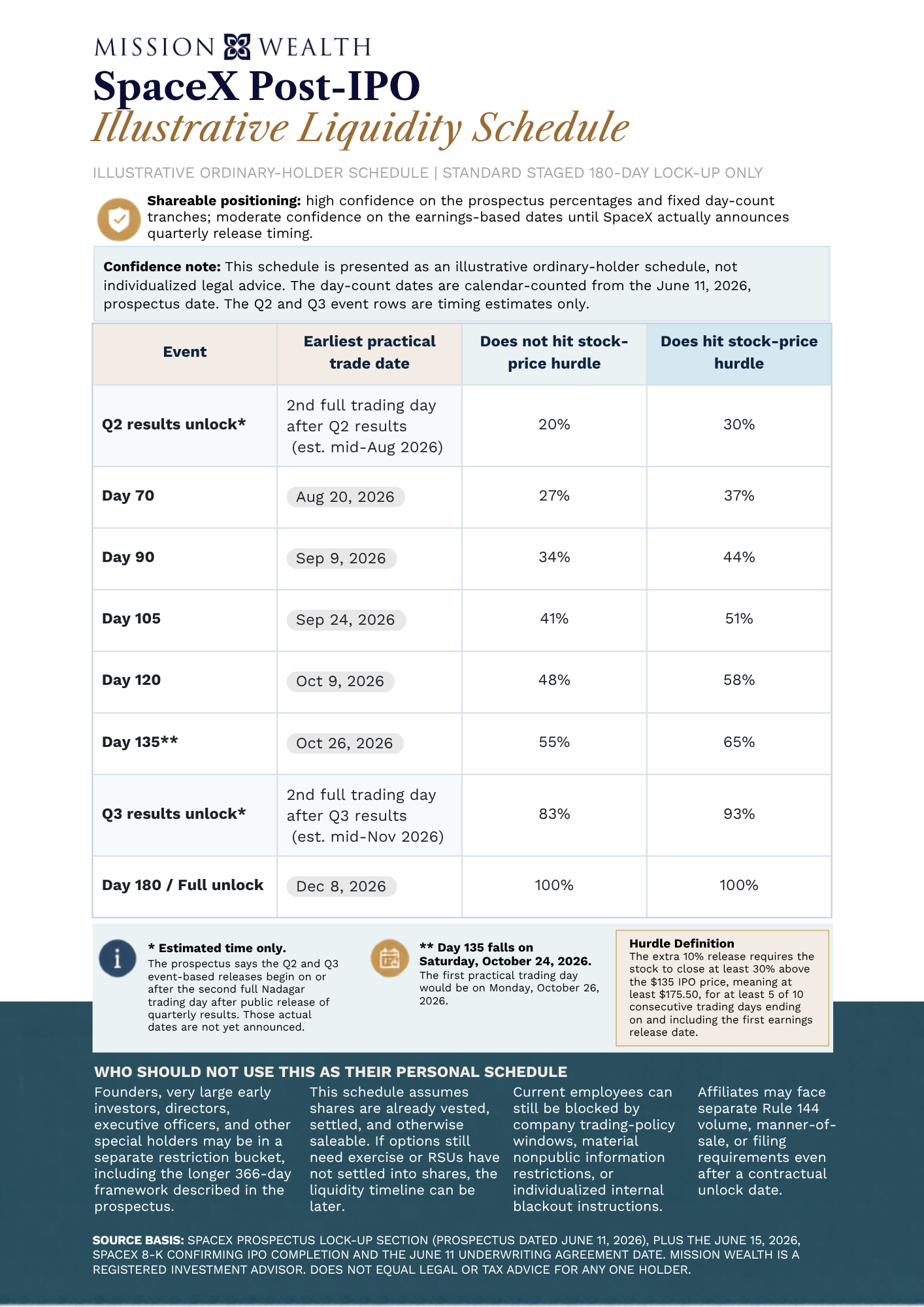
*For illustrative purposes only. Does not constitute tax, investment, or legal advice. Please contact your tax or legal professionals for specific advice.
Taxes Deserve as Much Attention as the Stock Price
Many IPO participants focus on potential investment gains while overlooking one of the largest variables affecting their financial outcome: taxes.
Different forms of equity can create different tax consequences.
Depending on your situation, proceeds may be taxed as:
- Ordinary income
- Short-term capital gains
- Long-term capital gains
Certain stock options may also introduce additional planning considerations, including Alternative Minimum Tax (AMT).
Perhaps the most challenging scenario occurs when taxes become due before shareholders have sufficient liquidity to pay them. Building a tax strategy before selling shares may help reduce surprises and provide greater flexibility as opportunities arise.
The Biggest Financial Risk May Be Concentration
One of the most common challenges following a successful IPO is concentrated wealth.
Years of equity compensation can leave employees with a substantial portion of their net worth tied to a single company. While that concentration may have helped create wealth, it can also increase portfolio risk moving forward.
Consider this question:
If your SpaceX holdings were converted to cash today, would you invest all of that money back into SpaceX?
For many investors, the answer is no.
That thought exercise illustrates the importance of separating emotional attachment from objective financial planning. Diversification isn’t about losing confidence in a company. It’s about reducing the financial impact if one investment experiences unexpected volatility.
Thinking About Buying SpaceX After the IPO?
The IPO also opens the door for investors who previously had little or no access to SpaceX shares. While excitement surrounding a newly public company is understandable, prospective investors should avoid making decisions based solely on headlines or momentum.
Instead, consider broader questions:
- How does SpaceX fit within my overall investment allocation?
- Am I becoming overly concentrated in one sector?
- Does this investment align with my long-term objectives?
- How does the company’s valuation compare to its expected future growth?
Owning a trending stock doesn’t automatically make it the right investment for every portfolio. Successful investing typically begins with a plan—not a headline.
Your Financial Goals Should Drive Every Decision
Two individuals with similar amounts of SpaceX stock may require completely different strategies based on factors such as your career stage, income, existing investments, tax bracket, retirement timeline, liquidity needs, family goals, or risk tolerance.
Someone planning to retire soon may prioritize preserving wealth and reducing concentration. Someone earlier in their career may choose to maintain greater exposure to long-term growth.
Neither approach is universally right. The most appropriate strategy is the one aligned with your personal financial goals. Talking to your financial advisor can help prioritize the right options for your situation.
A Liquidity Event Changes More Than Your Investment Portfolio
An IPO often creates opportunities well beyond investing. As wealth grows, financial planning becomes increasingly interconnected.
Questions that may not have been priorities before suddenly become important:
- Is my estate plan up to date?
- Do I have sufficient liability insurance?
- Should I establish trusts or think about legacy planning?
- How can I give to charity more efficiently?
- Are there opportunities to improve tax efficiency?
- Does my investment strategy still reflect my long-term objectives?
For many families, a successful IPO represents the beginning of a more sophisticated financial planning process.
Why Coordinated Advice Can Make a Difference
Major liquidity events often involve multiple professionals, including investment advisors, tax specialists, behavioral finance experts, estate planning attorneys, insurance professionals, and accountants.
While each provides valuable expertise, coordinating recommendations across disciplines can become increasingly complex.
Working with a team like Mission Wealth that understands how investment decisions affect taxes, estate planning, insurance, and long-term financial goals may help simplify that process while keeping every decision aligned with your broader objectives.
Frequently Asked Questions About SpaceX
1. Can SpaceX employees sell their shares immediately after the IPO?
No. Many employees remain subject to lock-up periods, vesting schedules, trading windows, or other company-specific restrictions that may delay when shares can be sold.
2. Should I sell my SpaceX shares after the IPO?
There is no universal answer. Decisions should consider taxes, concentration risk, liquidity needs, risk tolerance, and long-term financial goals rather than short-term market movements.
3. How are SpaceX RSUs and stock options taxed?
Tax treatment depends on the type of equity you own. RSUs, ISOs, NSOs, and purchased shares each follow different tax rules. Understanding those differences before selling can help improve planning.
4. Is SpaceX stock a good investment after the IPO?
That depends on your investment objectives, diversification strategy, valuation considerations, and overall portfolio—not simply on the company’s popularity or market momentum.
5. What is a lock-up period?
A lock-up period is a contractual restriction that limits when certain shareholders can sell their shares following an IPO. Lock-up agreements are common and help prevent large volumes of stock from entering the market immediately after trading begins.
6. How much of my portfolio should be invested in one company?
There is no single percentage appropriate for every investor. However, large, concentrated positions generally increase portfolio risk, making diversification an important planning consideration.
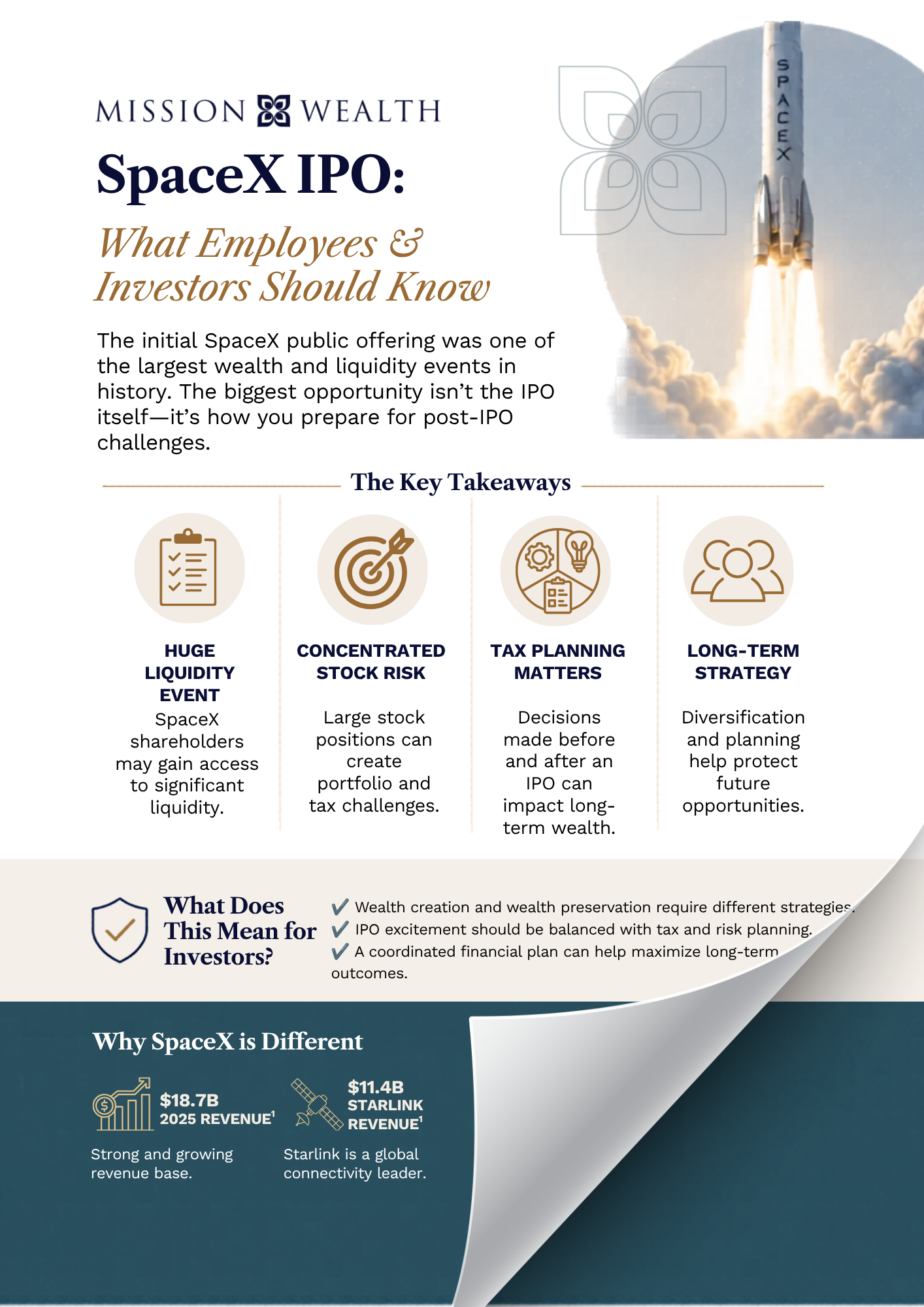
Download our Post-IPO Guide for SpaceX
Ready to Build a Strategy Around Your SpaceX Equity?
Whether you’re evaluating employee stock, planning for taxes after the IPO, or deciding how SpaceX fits within your broader investment portfolio, thoughtful planning can help you make more informed financial decisions.
Download the SpaceX IPO Planning and Lockup Checklist
Schedule a Complimentary Equity Review and Consultation
About the Author
Kyle Buffo helps individuals, executives, and families navigate complex financial decisions surrounding equity compensation, concentrated stock positions, liquidity events, retirement planning, and long-term wealth management. He works with clients to develop customized strategies that integrate investments, tax planning, estate considerations, and financial planning into one coordinated approach.
Customized Investment Management Solutions
At Mission Wealth, we develop customized, globally diversified, tax-efficient portfolios tailored to your financial plan and built to stand the test of time. Contact us below for a free portfolio review.Get Started Today
Investment Advice Fit For Your Needs
At Mission Wealth, we are deeply rooted in an evidence-based investment strategy built on decades of Nobel Prize-winning research. We ignore the media noise and Wall Street hype, relying instead on a long-term approach and proven principles that reward investors over time. For more information on Mission Wealth's investment strategies, please visit missionwealth.com.
To meet with a Mission Wealth financial advisor, please contact us online today or call us at (805) 882-2360.
Mission Wealth is a Registered Investment Advisor. This commentary reflects the personal opinions, viewpoints, and analyses of the Mission Wealth employees providing such comments. It should not be regarded as a description of advisory services provided by Mission Wealth or performance returns of any Mission Wealth client. The views reflected in the commentary are subject to change at any time without notice. Nothing in this commentary constitutes investment advice, performance data, or any recommendation that any particular security, portfolio of securities, transaction, or investment strategy is suitable for any specific person. Any mention of a particular security and related performance data is not a recommendation to buy or sell that security. Mission Wealth manages its clients’ accounts using a variety of investment techniques and strategies, which are not necessarily discussed in the commentary. Investments in securities involve the risk of loss. Past performance is no guarantee of future results.
07/26
Let's Keep in Touch!
Subscribe for exclusive content and timely tips to empower you on your financial journey. Our communications go straight into your inbox, so you'll never miss out on expert advice that can positively impact your life.
Recent Investment Insights Articles
SpaceX (SPCX) Guide: What Equity Holders and Investors Should Do Next
June 30, 2026The SpaceX IPO has arrived. Learn tax strategies, equity planning, diversification tips, and wealth management considerations for employees, early investors, and prospective shareholders....

Market Update 6/18/26
June 18, 2026It’s been a busy few days for financial markets, from SpaceX’s IPO to the latest FOMC meeting. Read our latest market update for our key takeaways....

Market Update 6/10/26
June 10, 2026Market volatility, rising inflation, geopolitical uncertainty, and shifting leadership underscore the importance of diversification, disciplined rebalancing, and a long-term investment strategy....