



It can be tempting to try to time the market, aiming to get out before the next market downturn, but history suggests it is much more beneficial for investors to fight that urge and remain invested over the long run. Sometimes investors think they can outsmart the market, other times fear and greed push them to make emotional, rather than rational, decisions.

Diversified Portfolio
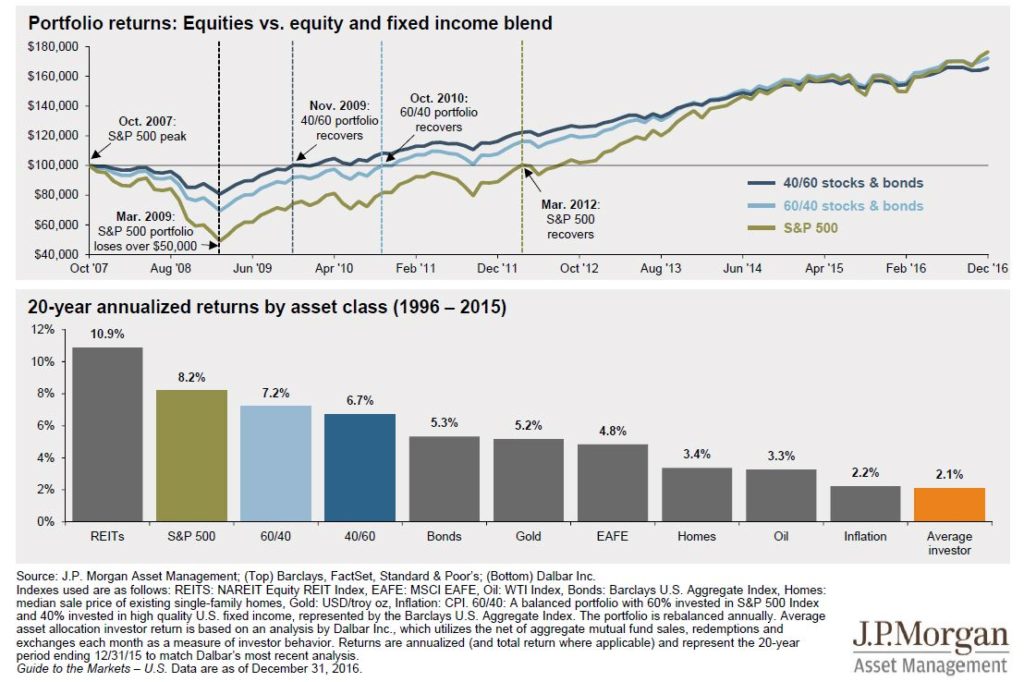
Some investors lament the fact that a diversified portfolio has failed to keep up with the S&P 500 in the raging bull market that we have experienced since 2009. However, this is only half of the story. As the first chart below shows, a blended portfolio that included equities and fixed income securities realized much smaller losses during the financial crisis, enabling these blended diversified portfolios to recover much more quickly than a portfolio of equities alone. While one-year equity returns have varied significantly since 1950 (+47% to -39%), a portfolio made up of a blend of equities and fixed income securities has not suffered a negative return over any five-year rolling period in the past 66 years.
The second chart below is based on a study that estimates that over the last 20 years, the average investor has achieved only a 2.1% annualized return as compared to more than 7% for an investor in a 60/40 stock/bond portfolio, largely because of badly timed (and often emotionally driven) investment decisions.
Systematic Re-balancing
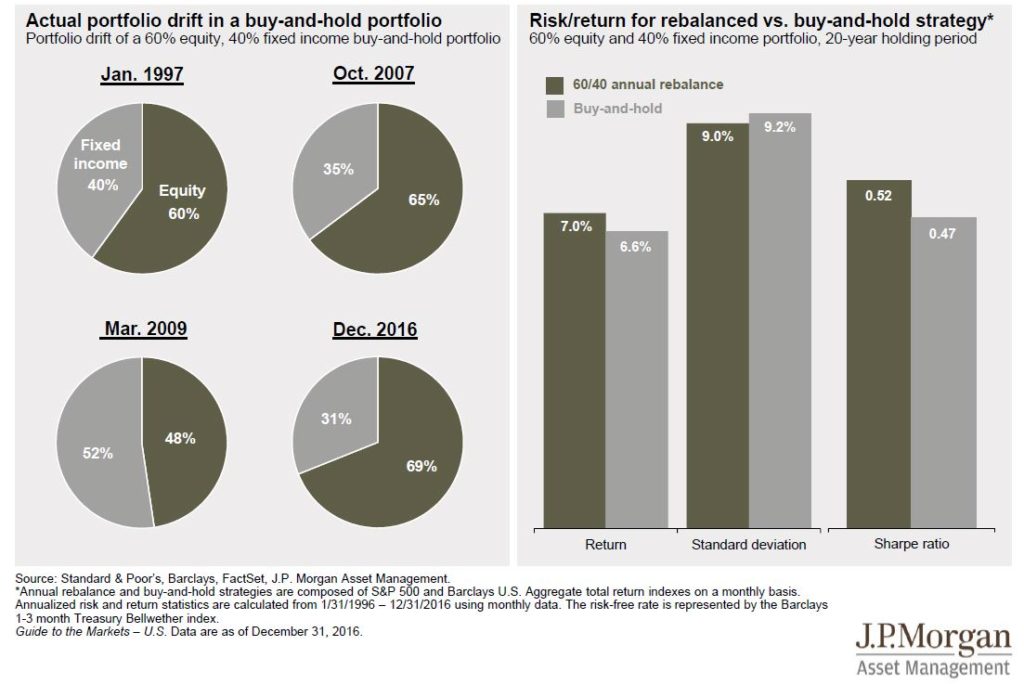
In addition to maintaining a diversified portfolio over the long run, a portfolio that is strategically rebalanced to target weights will help dampen volatility over business cycles. A buy-and-hold strategy that does not rebalance on a regular basis often leads to the best performing asset class dominating the portfolio, often shortly before the next market downturn when diversification and balance are most important. Systematic rebalancing helps investors remain in control, and has historically generated higher returns and less risk when compared to a buy-and-hold strategy.
Conclusion
While market pull-backs cannot be predicted, over the long-term, they can be expected. In fact, markets suffered double digit declines in 21 of the last 37 years, but despite the regular pull-backs, roughly 75% of those years ended with positive return. Investors need a plan for riding out volatile periods instead of reacting emotionally. The best thing you can do as an investor is to lengthen your time horizon. There has never been a 20-year period where you purchased and held the S&P 500 where you would have lost money. That includes the Great Depression, it includes the Great Recession, and that includes inflation.
At Mission Wealth, we employ a long-term diversified approach to investment management. We believe that staying invested in the market across business cycles, and using a systematic approach of regular rebalancing, are of the utmost importance. Staying true to our objective, “Your goals. Our mission,” your Advisor and the entire team at Mission Wealth work diligently to navigate the markets to help you achieve your life goals.
Are you living your life in a way that brings you joy and meaning?
Join the Inspired Living™ movement to elevate your past, present and future. Let us introduce you to prominent thought-leaders, life coaches, and influencers who can work together with you to develop your customized life plan. We will give you curated resources, actionable advice and targeted strategies during your journey of self-discovery. Then we will align your multi-dimensional and multi-faceted life with your ultimate vision so that you can become the BestU™ in your life journey. Learn More
Footnote:*Data sourced from JP Morgan Asset Management 2017 Market Insights.
986479 10/17
Mission Wealth is a Registered Investment Adviser. This commentary reflects the personal opinions, viewpoints, and analyses of the Mission Wealth employees providing such comments. It should not be regarded as a description of advisory services provided by Mission Wealth or performance returns of any Mission Wealth client. The views reflected in the commentary are subject to change at any time without notice. Nothing in this commentary constitutes investment advice, performance data, or any recommendation that any particular security, portfolio of securities, transaction, or investment strategy is suitable for any specific person. Any mention of a particular security and related performance data is not a recommendation to buy or sell that security. Mission Wealth manages its clients’ accounts using a variety of investment techniques and strategies, which are not necessarily discussed in the commentary. Investments in securities involve the risk of loss. Past performance is no guarantee of future results.
KEY TAKEAWAYS
A diversified portfolio of equities and fixed income has not suffered a negative return over any five-year rolling period in the past 66 years. Studies show the average investor achieves only about 2% annualized returns compared to over 7% for a balanced 60/40 portfolio, largely due to emotionally driven decisions. Staying invested through market cycles and systematically rebalancing a diversified portfolio are key strategies for building long-term wealth.
Schedule a complimentary 30-minute discovery call to discuss your unique situation and financial goals.

"*" indicates required fields
By providing a telephone number and submitting the form, you are consenting to be contacted by SMS text message and agreeing to our privacy policy and disclaimers. Message frequency may vary. Message and data rates may apply. Reply STOP to opt out of further messaging. Reply HELP for more information.

Client Development Advisor
or call us: 805-902-4550
"*" indicates required fields
Schedule a complimentary 30-minute discovery call to discuss your unique situation and financial goals.
Prefer a phone call? Call us: 805-902-4550
For general inquiries: click here.
By providing a telephone number and submitting the form, you are consenting to be contacted by SMS text message and agreeing to our privacy policy and disclaimers. Message frequency may vary. Message and data rates may apply. Reply STOP to opt out of further messaging. Reply HELP for more information.