



The Fed just raised interest rates, but its updated outlook provided some important insights into the path for monetary policy moving forward. Below are our key takeaways and thoughts on what the decision means for markets and portfolios.
The Fed raised interest rates by 0.25% at its September Federal Open Market (FOMC) meeting, bringing the target range for the federal funds rate to 3.75%-4.00%. The decision was unanimous and largely anticipated, with markets assigning approximately a 90% probability of a rate increase ahead of the meeting. The Fed’s relatively succinct statement noted that economic activity continues to expand “at a solid pace” and, despite elevated geopolitical uncertainty, domestic spending has remained resilient, productivity growth is strong, and capital investment remains robust.
Turning to the Fed’s dual mandate, policymakers continue to view the labor market as largely balanced. Inflation, however, remains elevated. With employment conditions providing relatively little cause for concern, the Fed’s focus has increasingly shifted toward getting inflation under control. Accordingly, the Fed raised rates in an effort to support a more timely return to its 2% inflation objective.
Of particular interest were the Fed’s updated economic projection materials, or “dot plot.” Based on these projections, the Fed now expects one more 0.25% hike through the balance of 2026. Importantly, this is less aggressive than market expectations heading into the meeting, which had been pricing in two to three additional 0.25% hikes this year. The projections also indicate the Fed anticipates holding rates steady through 2027. In contrast, market expectations ahead of today’s announcement had been pricing in approximately four 0.25% interest rate hikes between now and the end of 2027.
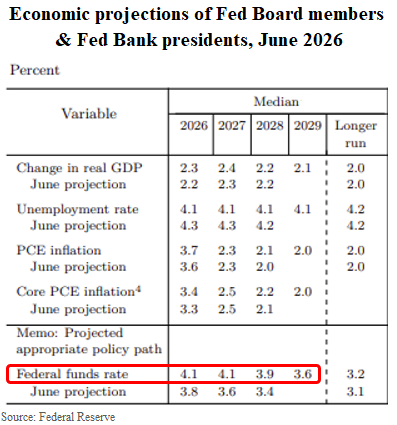
The Fed revised its 2026 GDP growth forecast higher to 2.3% from 2.2% previously, while lowering its expected year-end unemployment rate to 4.1% from 4.3%. At the same time, expected PCE inflation increased to 3.7% from 3.6%, with core PCE inflation revised to 3.4% from 3.3%. Said another way, the Fed now expects somewhat stronger economic growth and a healthier labor market, but also somewhat higher inflation – a combination that supports a more a restrictive monetary policy stance.
At his subsequent press conference, Fed Chair Warsh highlighted three factors underpinning the decision to raise rates:
Warsh also characterized the labor market as balanced, pointing to employment conditions consistent with full employment. At the same time, he emphasized that inflation has remained above target for too long. With the employment side of the Fed’s mandate in relatively good shape, policymakers are increasingly focused on addressing still-elevated inflation. Warsh described today’s action as removing a “dose of accommodation” and indicated that he would be hard-pressed to characterize current financial conditions as restrictive.
From an investment standpoint, the current environment reinforces why we construct broadly diversified portfolios with dedicated allocations to asset classes that respond differently across market cycles.
Periods like the current environment highlight the value of maintaining exposure across multiple sources of return rather than positioning portfolios around a single economic or interest-rate outcome. Stocks, fixed income, and alternative assets each respond differently to changes in economic growth, inflation, and interest rates. We believe maintaining broad diversification and remaining disciplined in our approach to portfolio rebalancing leaves portfolios better positioned to navigate an uncertain environment while remaining focused on long-term financial objectives.
Contact us today for a complimentary consultation and review of your investment portfolio.
Mission Wealth is a Registered Investment Adviser. This commentary reflects the personal opinions, viewpoints, and analyses of the Mission Wealth employees providing such comments. It should not be regarded as a description of advisory services provided by Mission Wealth or performance returns of any Mission Wealth client. The views reflected in the commentary are subject to change at any time without notice. Nothing in this commentary constitutes investment advice, performance data, or any recommendation that any particular security, portfolio of securities, transaction, or investment strategy is suitable for any specific person. Any mention of a particular security and related performance data is not a recommendation to buy or sell that security. Mission Wealth manages its clients’ accounts using a variety of investment techniques and strategies, which are not necessarily discussed in the commentary. Investments in securities involve the risk of loss. Past performance is no guarantee of future results.
KEY TAKEAWAYS
Investment outlook remains steady as the Fed raised interest rates by 0.25%, bringing the fed funds target range to 3.75%–4.00%. While inflation remains elevated, the economy continues to show resilience through solid consumer spending, strong business investment, and a balanced labor market. The Fed’s updated projections point to one additional rate hike this year and no further tightening in 2027, suggesting a less aggressive path than markets had anticipated. Higher rates may create near-term pressure for bonds and Growth stocks, while also improving forward-looking fixed income returns and supporting floating-rate alternative strategies. Elevated dispersion across asset classes reinforces the value of broad diversification, disciplined rebalancing, and maintaining exposure to multiple sources of return.
Schedule a complimentary 30-minute discovery call to discuss your unique situation and financial goals.

"*" indicates required fields
By providing a telephone number and submitting the form, you are consenting to be contacted by SMS text message and agreeing to our privacy policy and disclaimers. Message frequency may vary. Message and data rates may apply. Reply STOP to opt out of further messaging. Reply HELP for more information.

Client Development Advisor
or call us: 805-902-4550
"*" indicates required fields
Schedule a complimentary 30-minute discovery call to discuss your unique situation and financial goals.
Prefer a phone call? Call us: 805-902-4550
For general inquiries: click here.
By providing a telephone number and submitting the form, you are consenting to be contacted by SMS text message and agreeing to our privacy policy and disclaimers. Message frequency may vary. Message and data rates may apply. Reply STOP to opt out of further messaging. Reply HELP for more information.