



At Mission Wealth we proactively tax-loss harvest across our client’s taxable accounts where suitable and when opportunities present themselves. Tax-loss harvesting can provide significant tax savings and allows us to enhance the after-tax returns for our clients.

We’ve all heard the term tax-loss harvesting at some point but what does it mean to investors? Is there a silver lining to a down market? Click the video to watch, or read the text beneath it to learn more.
So what is tax-loss harvesting?
Tax-loss harvesting is a method applied to taxable accounts – such as an individual account or a Trust – whereby we sell an investment that is trading at a loss, and immediately use those proceeds to purchase a very similar investment position.
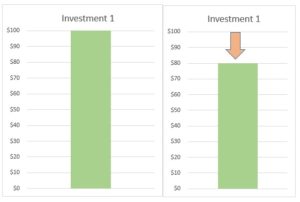
Let’s say we bought an investment, we’ll call it “Investment 1” for $100 per share a month ago. Let’s also assume the market sold off over the course of the month and that investment is now worth $80 per share.
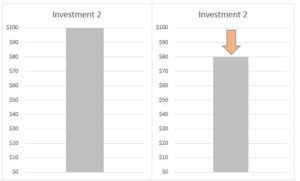
Now, there just so happens to be another investment, let’s call it “Investment 2” which we don’t currently own but is very similar to Investment 1, and it has also fallen in value from $100 to $80 per share.
Because the two investments have very similar profiles – maybe they are both small cap stock investments, as an example – we could Tax-Loss Harvest Investment 1 by selling it, realizing a $20 loss per share, and using the $80 proceeds to immediately buy Investment 2.
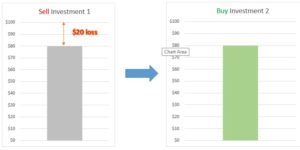
As a result of this transaction, we maintain our portfolio allocation – say to small cap stocks – so if the market rebounds we will fully participate. At the same time, we have switched from one investment to another and realized a loss of $20 per share. That loss may help enhance after tax returns.
Losses can be used in a variety of ways:
Let’s look at a concrete example.
In the example below, a $25,000 loss from Investment B can be applied to first offset $20,000 of gains that were triggered from a sale of Investment A.
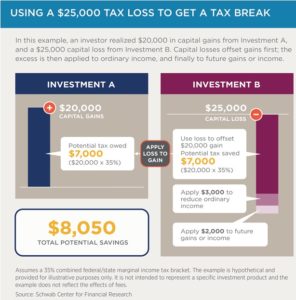
Next, $3,000 of the loss can be used to offset ordinary income, while the remaining $2,000 of losses can be saved to help offset future gains or income. In this example, the total tax savings exceed $8,000.
At Mission Wealth, we proactively tax loss harvest across our client’s taxable accounts where suitable and when opportunities present themselves. Tax-loss harvesting can provide significant tax savings and benefits for our clients.
If you’d like to learn more about our investment services, check out our investments page.
00366839 05/20
Mission Wealth is a Registered Investment Adviser. This commentary reflects the personal opinions, viewpoints, and analyses of the Mission Wealth employees providing such comments. It should not be regarded as a description of advisory services provided by Mission Wealth or performance returns of any Mission Wealth client. The views reflected in the commentary are subject to change at any time without notice. Nothing in this commentary constitutes investment advice, performance data, or any recommendation that any particular security, portfolio of securities, transaction, or investment strategy is suitable for any specific person. Any mention of a particular security and related performance data is not a recommendation to buy or sell that security. Mission Wealth manages its clients’ accounts using a variety of investment techniques and strategies, which are not necessarily discussed in the commentary. Investments in securities involve the risk of loss. Past performance is no guarantee of future results.
KEY TAKEAWAYS
Tax-loss harvesting involves selling an investment at a loss and immediately purchasing a similar position, allowing you to realize tax benefits while maintaining your portfolio allocation. The harvested losses can offset capital gains elsewhere in the portfolio, reduce ordinary income by up to $3,000 annually, and carry forward to offset future gains. This strategy is most effective in taxable accounts during periods of market volatility, when more opportunities to capture losses typically arise.
Schedule a complimentary 30-minute discovery call to discuss your unique situation and financial goals.

"*" indicates required fields
By providing a telephone number and submitting the form, you are consenting to be contacted by SMS text message and agreeing to our privacy policy and disclaimers. Message frequency may vary. Message and data rates may apply. Reply STOP to opt out of further messaging. Reply HELP for more information.

Client Development Advisor
or call us: 805-902-4550
"*" indicates required fields
Schedule a complimentary 30-minute discovery call to discuss your unique situation and financial goals.
Prefer a phone call? Call us: 805-902-4550
For general inquiries: click here.
By providing a telephone number and submitting the form, you are consenting to be contacted by SMS text message and agreeing to our privacy policy and disclaimers. Message frequency may vary. Message and data rates may apply. Reply STOP to opt out of further messaging. Reply HELP for more information.