



Whether you’re a business owner, building a retirement plan, an independent woman, or a professional, it’s never a bad idea to understand the “why” behind investment decisions. Shifting your investment approach is a powerful way towards managing uncertainty, towards positively leveraging your absolute returns.
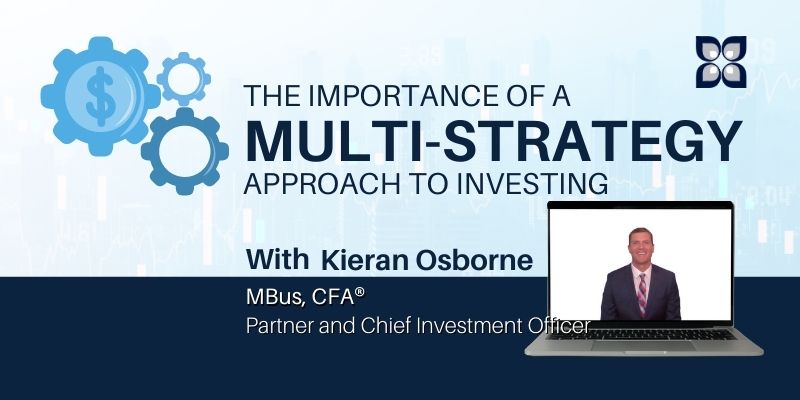
Investing in the stock market is often unpredictable, but the value of a diversified multi-strategy investment portfolio can help to reduce overall risk. In this video, learn how investors can utilize a multi-strategy approach to investing by using both active and passive strategies.
Watch the video now, or keep reading for the top takeaways.
 What is a multi-strategy approach to investing?
 When considering various investment options – be it mutual funds, exchange traded funds, or other types of investments – most investment strategies fall into one of two buckets: passive or active.
A passive strategy typically employs a low-cost approach to investing, usually following an index or enhanced index methodology. On the other hand, an active approach to investing aims to utilize manager skill to outperform within certain areas of the market. Active funds tend to have higher expense ratios than passive funds to compensate for the additional layer of manager input and oversight. Importantly, we believe there is room within a portfolio for both active and passive funds. And we believe using both passive and active approaches where it makes sense may ultimately enhance the long-term returns of a broadly diversified portfolio.
Within highly efficient markets, we employ passive strategies in the form of low-cost index solutions. U.S. large cap stocks are a good example of a highly efficient market.
Empirical evidence shows that on average, active managers do not add any value within this asset class. In fact, over extended periods of time, active managers, on average, have a very poor record. As this chart illustrates, between 80% and 90% of all actively managed funds underperform a passive benchmark – in this case the S&P 500 over five, ten and 15 year periods. You can see similar results hold true for mid-cap and small cap U.S. stocks.
Taking this data, at best you have a 20% chance of picking an active manager who will outperform in the forthcoming period. Oh and by the way, there is no correlation between past performance and future results. This is generally considered somewhat of a warning, saying that no one should assume an investment will continue to perform well in future purely because it’s done well in the past. Correspondingly, don’t discount an investment just because it’s done poorly in the short-term as it could improve.
In fact many of the best performers in one time period may end up being amongst the worst in subsequent time periods. For this reason we believe an index-based approach to investing within U.S. large cap and other similarly highly efficient markets has a better chance of outperforming actively managed strategies.
We believe less efficient asset classes – such as high yield bonds, emerging markets debt or direct credit – are best suited to an actively managed fund approach.
Think about the efficiency of an asset class this way; if you asked any of your friends whether they have ever bought a stock, almost all of them would reply yes. However, if you asked that same friend if they have ever bought a high yield bond or an emerging market bond, the reply would be much different. Simply put, high yield bonds, emerging markets debt and direct credit are all examples of much less liquid – and therefore –more inefficient asset classes where employing high quality active managers may add value. As an example, our preferred high yield bond manager has consistently outperformed more than 80% of peer group funds over extended periods.
We believe utilizing a multi-strategy approach to investing, incorporating both active and passive strategies and being thoughtful about which asset classes are best suited for each type of approach, may ultimately enhance long-term expected returns within our clients broadly diversified portfolios.
At Mission Wealth we work closely with you to identify your goals and build your roadmap, while helping you to consider your future options and optimize your financial security. To learn more, click here or reach out to our experienced team.
00397832 03/21
Mission Wealth is a Registered Investment Adviser. This commentary reflects the personal opinions, viewpoints, and analyses of the Mission Wealth employees providing such comments. It should not be regarded as a description of advisory services provided by Mission Wealth or performance returns of any Mission Wealth client. The views reflected in the commentary are subject to change at any time without notice. Nothing in this commentary constitutes investment advice, performance data, or any recommendation that any particular security, portfolio of securities, transaction, or investment strategy is suitable for any specific person. Any mention of a particular security and related performance data is not a recommendation to buy or sell that security. Mission Wealth manages its clients’ accounts using a variety of investment techniques and strategies, which are not necessarily discussed in the commentary. Investments in securities involve the risk of loss. Past performance is no guarantee of future results.
KEY TAKEAWAYS
A multi-strategy investment approach blends passive and active management to capitalize on the strengths of each. In highly efficient markets like U.S. large-cap stocks, low-cost index funds consistently outperform the vast majority of active managers over time. Deploying active strategies selectively in less efficient market segments can add value while keeping overall portfolio costs in check.
Schedule a complimentary 30-minute discovery call to discuss your unique situation and financial goals.

"*" indicates required fields
By providing a telephone number and submitting the form, you are consenting to be contacted by SMS text message and agreeing to our privacy policy and disclaimers. Message frequency may vary. Message and data rates may apply. Reply STOP to opt out of further messaging. Reply HELP for more information.

Client Development Advisor
or call us: 805-902-4550
"*" indicates required fields
Schedule a complimentary 30-minute discovery call to discuss your unique situation and financial goals.
Prefer a phone call? Call us: 805-902-4550
For general inquiries: click here.
By providing a telephone number and submitting the form, you are consenting to be contacted by SMS text message and agreeing to our privacy policy and disclaimers. Message frequency may vary. Message and data rates may apply. Reply STOP to opt out of further messaging. Reply HELP for more information.