

No results can be found

For Anthropic employees, the IPO represents more than a financial milestone. Understanding equity release schedules, trading restrictions, taxes, and the personal decisions that accompany sudden wealth can help turn a liquidity event into a long-term financial opportunity.
Anthropic officially priced its initial public offering at $83 per share on November 18, 2026, with shares expected to begin trading on the Nasdaq Global Select Market under the ticker ANT on November 19.
The offering includes 980 million Class A shares, representing approximately $81.34 billion in gross offering value and making it the largest IPO on record by proceeds. The company has also granted underwriters a 30-day option to purchase up to 147 million additional shares.
For Anthropic employees, this milestone creates important financial opportunities—and complex decisions involving equity compensation, RSU taxation, trading restrictions, diversification, and charitable giving.
At Mission Wealth, we believe navigating a technology IPO requires more than understanding when shares become available. It requires a coordinated financial strategy that considers both the technical complexities of equity compensation and the personal implications of significant wealth.
According to Anthropic’s publicly filed SEC prospectus, shares will become eligible for sale in stages, subject to applicable restrictions. These dates remain subject to change.
| Date | Key milestone |
| November 19, 2026 | Scheduled IPO, initial RSU release, and first day of limited trading. Eligible employees (certain directors, officers, and employees) may transfer up to 10% of applicable equity holdings, subject to restrictions. |
| Late February–March 2027 | Second limited trading window, permitting additional eligible transactions and the first opportunity to establish certain 10b5-1 plans. |
| Up to 1 year post-IPO | Remaining staged releases run across multiple separate release dates during the year following the offering. |
The first window includes six trading days, accounting for the Thanksgiving market holiday and the early market close on November 27.
Why this matters: Employees should distinguish between the value of their equity, the amount eligible for sale, and the proceeds available after taxes. These figures may differ substantially.
Anthropic’s IPO was generally well received by investors, with ANT shares closing their first trading day 17% above the $83 IPO price, reflecting strong investor demand, although shares finished below their opening trading price.
According to Kieran Osborne, Chief Investment Officer at Mission Wealth, the debut occurred against a backdrop of broader market volatility, including concerns about a potentially more hawkish Federal Reserve, geopolitical uncertainty in the Middle East, AI-related risks, recent NVIDIA headlines, and tighter semiconductor export controls.
While some investors may have shifted capital from other large technology companies into ANT, the broader market weakness appeared more closely tied to these macroeconomic concerns than to Anthropic’s IPO itself.
Anthropic’s IPO structure includes multiple phases of share eligibility rather than a single lock-up expiration date.
During the first limited trading window, eligible employees may sell, donate, or transfer up to 10% of their outstanding equity as of October 31, 2026. Unvested equity counts toward calculating this limit, but only vested and otherwise eligible equity can be transacted.
Following the public release of Anthropic’s FY2026 annual financial results, eligible employees may transfer up to an additional 35% of applicable locked-up shares, bringing the cumulative allowance to 45%, subject to the prospectus’s conditions.
The prospectus excerpt also describes additional shareholder lock-up provisions, including releases tied to the IPO date and subsequent quarterly earnings announcements.
These provisions vary by shareholder category and are not necessarily identical to employee trading-window permissions. For employees, understanding how these restrictions interact is essential. A financial plan should address how much equity can be sold, when transactions are permitted, and whether a gradual diversification strategy makes sense.
A Rule 10b5-1 plan can provide a structured approach to future company stock sales under predetermined instructions and applicable regulatory requirements.
Employees considering Rule 10b5-1 plans should review applicable company policies, trading restrictions, and regulatory requirements before establishing a plan.
For many employees, RSU taxation may be one of the most consequential aspects of the IPO.
Anthropic’s initial RSU release will occur on November 19, including eligible awards originally scheduled to vest on November 20. The one-day vesting acceleration applies to employees meeting the company’s stated eligibility requirements.
The released RSUs will be taxed using the IPO’s pre-trading price.
For example, Anthropic’s IPO was priced at $83 per share. For an employee receiving 10,000 taxable RSU shares valued at that price, the resulting ordinary compensation income would generally be $830,000, assuming all 10,000 shares settle and become taxable at that value.
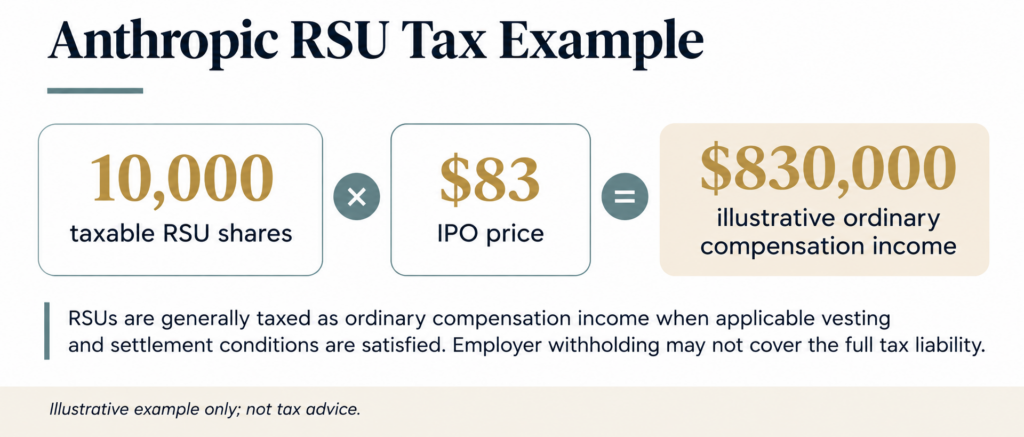
This could create a significant tax obligation even if the employee does not immediately sell the shares. Employer withholding may not cover the full tax liability, making coordinated tax planning especially important.
Importantly, Anthropic’s share withholding may not cover an employee’s full tax liability. Shares purchased or sold after the IPO begins trading may have a different market price than the $83 offering price.
Employees should distinguish the value used for taxable RSU settlement from the proceeds they may ultimately receive when selling shares and consider federal and state taxes, additional income, and estimated tax payments.
After RSU settlement, subsequent appreciation or depreciation generally creates capital gains or losses when the shares are sold.
What happens if your company withholds less than your actual tax liability? And how should you decide whether to sell additional shares, hold them, or diversify? These decisions become particularly important when equity compensation pushes your income significantly higher in a single tax year.
Anthropic’s public debut adds another major AI-related company to the stock market, reinforcing concerns about market concentration and the importance of maintaining a diversified investment portfolio.
Kieran also notes that despite recent market volatility, underlying economic and corporate fundamentals remain constructive. Economic data has generally exceeded expectations, supporting strong corporate earnings growth. Earnings have also outpaced stock price appreciation, bringing the S&P 500’s price-to-earnings (P/E) ratio closer to its 30-year historical average.
These factors, combined with the recent market pullback, may provide a more constructive environment for future stock market returns. However, elevated market concentration could contribute to continued volatility.
For Anthropic employees, this reinforces an important consideration: Even when you believe strongly in your company’s future, your long-term financial security should not depend entirely on a single stock’s performance.
A thoughtful diversification strategy can help balance continued participation in Anthropic’s potential growth with the need to manage risk, taxes, and long-term financial goals.
An IPO can dramatically change your financial circumstances without immediately changing how you feel about money.
For technology professionals who have spent years building a company, newfound wealth may introduce unexpected questions about financial security, family, career, and personal identity.
Having significantly more wealth does not necessarily mean feeling more financially secure. Some individuals may hesitate to spend or diversify their investments, while others may feel pressure to make major purchases or lifestyle changes.
Behavioral finance helps explain how emotional attachment, loss aversion, and familiarity with company stock can influence financial decisions.
Significant wealth can also change family conversations. You and your spouse or partner may have different ideas about spending, investing, charitable giving, or supporting loved ones.
These decisions involve questions about responsibility, fairness, and personal priorities—not simply financial capacity.
Perhaps the most meaningful opportunity following an IPO is greater freedom to choose how you spend your time. For some, that means early retirement. For others, it may mean starting another business, supporting charitable causes, or spending more time with family.
Rather than beginning with what you can now afford, consider asking:
At Mission Wealth, our Psychology of Wealth approach recognizes that financial decisions are shaped by personal experiences, beliefs, relationships, and values.
Understanding these influences can help individuals make decisions that support both their financial future and the life they want to build.
Anthropic priced its IPO at $83 per share on November 18, 2026, with shares scheduled to begin trading on Nasdaq under the ticker ANT on November 19.
Anthropic’s IPO includes multiple staged share releases, rather than one universal lock-up expiration date. Eligibility depends on shareholder classification, applicable restrictions, and the company’s release schedule.
RSUs are generally taxed as ordinary compensation income when applicable vesting and settlement conditions are satisfied. Subsequent share-price changes may generate capital gains or losses when shares are sold.
An IPO is not the finish line of financial planning. For many technology professionals, it is the beginning of an entirely new financial chapter.
Mission Wealth advisors help technology executives, founders, and employees with concentrated equity positions navigate complex wealth transitions through comprehensive financial planning.
Our approach integrates equity compensation planning, investment diversification, tax strategy, charitable giving, estate planning, and long-term financial independence.
Have Significant Equity Compensation? Let’s Look at Your Options.
Whether you’re preparing for an IPO, approaching a trading window, or considering how to diversify a concentrated stock position, your decisions can have significant long-term tax and financial implications.
Mission Wealth offers an introductory conversation to help you identify potential planning opportunities, including equity compensation, tax exposure, diversification, and long-term wealth planning. Schedule a meeting here.
This article is for educational purposes only and does not constitute individualized investment, legal, or tax advice. IPO dates, trading restrictions, and equity compensation terms are subject to change. Mission Wealth is not affiliated with Anthropic.
Mission Wealth is a Registered Investment Adviser. This commentary reflects the personal opinions, viewpoints, and analyses of the Mission Wealth employees providing such comments. It should not be regarded as a description of advisory services provided by Mission Wealth or performance returns of any Mission Wealth client. The views reflected in the commentary are subject to change at any time without notice. Nothing in this commentary constitutes investment advice, performance data, or any recommendation that any particular security, portfolio of securities, transaction, or investment strategy is suitable for any specific person. Any mention of a particular security and related performance data is not a recommendation to buy or sell that security. Mission Wealth manages its clients’ accounts using a variety of investment techniques and strategies, which are not necessarily discussed in the commentary. Investments in securities involve the risk of loss. Past performance is no guarantee of future results.
KEY TAKEAWAYS
Schedule a complimentary 30-minute discovery call to discuss your unique situation and financial goals.

"*" indicates required fields
By providing a telephone number and submitting the form, you are consenting to be contacted by SMS text message and agreeing to our privacy policy and disclaimers. Message frequency may vary. Message and data rates may apply. Reply STOP to opt out of further messaging. Reply HELP for more information.
or call us: 805-902-4550
"*" indicates required fields
Schedule a complimentary 30-minute discovery call to discuss your unique situation and financial goals.
Prefer a phone call? Call us: 805-902-4550
For general inquiries: click here.
By providing a telephone number and submitting the form, you are consenting to be contacted by SMS text message and agreeing to our privacy policy and disclaimers. Message frequency may vary. Message and data rates may apply. Reply STOP to opt out of further messaging. Reply HELP for more information.