



In this video, we’ll cover the benefits of Asset Location. While asset allocation involves the optimal portfolio mix across asset classes, asset location focuses on how to most tax efficiently distribute those asset classes amongst different account types.

We’ve heard of asset allocation, but how about asset location? Learn about how asset location fits into an investment strategy. Click the video to watch, or read the text beneath it to learn more.
Click here to watch our 6-minute video that explains asset allocation.
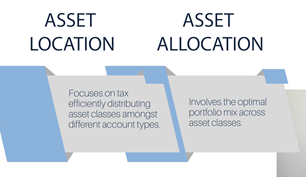
Since different account types have different tax considerations, by incorporating asset location can help maximize after-tax returns for our clients.
Certain client-specific requirements such as short-term cash needs may dictate to an extent what assets to hold and in what accounts, however generally speaking we are able to invest more tax efficiently by incorporating asset location into consideration.
Let’s say you have three investment 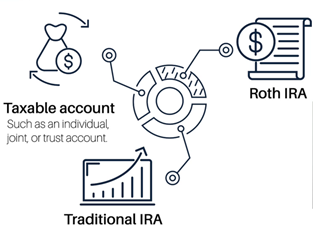 accounts within your broad investment portfolio: the first is a taxable account – such as an individual, joint, or trust account. The second is a Roth IRA, and the third account is a Traditional IRA.
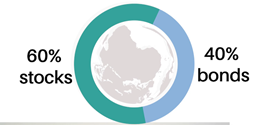 Within the scope of this broad portfolio – which might have an overall target allocation of, say 60% stocks and 40% bonds – we can incorporate asset location:
When faced with a decision to locate growth assets (such as stocks), across the different account types, it’s typically better to prioritize allocating high growth assets in a 1) Roth, since that minimizes expected future taxes, then to a 2) taxable account, since any future distributions on a taxable account are likely to be taxed at Long Term capital gains rates, and lastly to a 3) traditional IRA since future distributions will be taxed at your future marginal tax rate and thus incur the largest tax burden.
Studies show that incorporating tax-efficient investing – like asset location – into an investment portfolio can add 0.41% of additional performance benefit annually.*
Again, specific client circumstances may dictate asset location to a degree, but generally speaking, by incorporating asset location and tax considerations may ultimately help maximize after tax returns.
If you are looking for guidance on investment decisions, read more about our services or contact us to be connected with an advisor.
Source: 0.41% Tax Trading Overlay calculation is an average derived from the “Tax-Efficient Investing: Solutions for Maximizing After-Tax Returns” white paper by Vanguard (Donaldson and Kinniry 07). These benefits are hypothetical and not guaranteed. Each investor situation is unique.
00378005 09/20
Mission Wealth is a Registered Investment Adviser. This commentary reflects the personal opinions, viewpoints, and analyses of the Mission Wealth employees providing such comments. It should not be regarded as a description of advisory services provided by Mission Wealth or performance returns of any Mission Wealth client. The views reflected in the commentary are subject to change at any time without notice. Nothing in this commentary constitutes investment advice, performance data, or any recommendation that any particular security, portfolio of securities, transaction, or investment strategy is suitable for any specific person. Any mention of a particular security and related performance data is not a recommendation to buy or sell that security. Mission Wealth manages its clients’ accounts using a variety of investment techniques and strategies, which are not necessarily discussed in the commentary. Investments in securities involve the risk of loss. Past performance is no guarantee of future results.
KEY TAKEAWAYS
While asset allocation determines the right mix of investments, asset location focuses on which account types, such as taxable, Roth IRA, or Traditional IRA, should hold each asset class to maximize after-tax returns. Tax-free municipal bonds and growth-oriented investments are generally best suited for taxable accounts, while high-income-generating assets belong in tax-deferred accounts. Prioritizing high-growth assets in Roth accounts, then taxable accounts, then traditional IRAs can significantly enhance long-term after-tax wealth accumulation.
Schedule a complimentary 30-minute discovery call to discuss your unique situation and financial goals.

"*" indicates required fields
By providing a telephone number and submitting the form, you are consenting to be contacted by SMS text message and agreeing to our privacy policy and disclaimers. Message frequency may vary. Message and data rates may apply. Reply STOP to opt out of further messaging. Reply HELP for more information.

Client Development Advisor
or call us: 805-902-4550
"*" indicates required fields
Schedule a complimentary 30-minute discovery call to discuss your unique situation and financial goals.
Prefer a phone call? Call us: 805-902-4550
For general inquiries: click here.
By providing a telephone number and submitting the form, you are consenting to be contacted by SMS text message and agreeing to our privacy policy and disclaimers. Message frequency may vary. Message and data rates may apply. Reply STOP to opt out of further messaging. Reply HELP for more information.