



It’s not easy to keep up with complex tax laws that always seem to be changing, much less figure out how they might affect you personally. Even so, it’s important to consider the potential impact of taxes when making many types of financial decisions.
The IRS automatically adjusts the standard deduction and income tax brackets annually for inflation. The rate of inflation rose to 40-year highs in 2022, so the 7% increases for 2023 are the largest since these adjustments began in 1985. The standard deduction is $13,850 for single filers in 2023 (up $900 from 2022) and $27,700 for married joint filers (up $1,800).
The filing deadline for 2023 federal income tax returns is April 15, 2024, (April 17 in Maine and Massachusetts, due to local holidays). Even though the 2024 tax year is well underway, there may still be time to take steps that lower your tax liability for 2023.
U.S. tax rates increase at progressively higher income levels or brackets (see table). If your taxable income goes up and moves you into a higher bracket, the resulting tax increase might not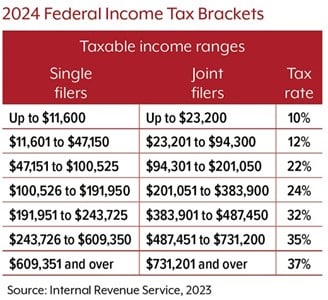 be as bad as it may appear at first glance. For example, if you and your spouse are filing jointly for 2023 and have a taxable income of $110,000, you are in the 22% tax bracket. However, you will not pay a 22% rate on all of your income, only on the amount over $94,300.
Determining the value of certain deductions also depends on where your income falls in the tax brackets. Using the same example, a $10,000 deduction would reduce your income from $110,000 to $100,000 and theoretically reduce your tax liability by $2,200 (22% x $10,000). For a $20,000 deduction, you would have to calculate the amount of the deduction that falls in the 22% and 12% brackets: 22% x $15,700 + 12% x $4,300 ($3,454 + $516 = $3,970).
Although it’s helpful to know your marginal rate, your effective tax rate — the average rate at which your income is taxed (determined by dividing your total taxes by taxable income) — may offer a better way to gauge your tax liability.
Wildfires, tornadoes, severe storms, flooding, landslides. The United States was struck by a record number of billion-dollar catastrophes in 2023. If something you own was damaged or destroyed by a disaster, and your loss exceeds 10% of your adjusted gross income (AGI) plus $100, you may be able to claim an itemized deduction on your federal income tax return.
This typically applies to large losses that are uninsured or subject to a high deductible. For 2018 to 2025, a personal casualty loss is deductible only if it is attributable to a federally declared disaster.
The rules relating to casualty losses can be complicated. If you have suffered a significant loss, it may be worthwhile to consult a tax professional.
If you can’t meet the filing deadline for any reason, you can file for and obtain an automatic six-month extension using IRS Form 4868. (Otherwise, if you owe taxes, you might face a failure-to-file penalty.) You must file for an extension by the original due date for your return. For most individuals, that’s April 15, 2024; the deadline for extended returns is October 15, 2024.
An extension to file your tax return does not postpone payment of taxes. Estimate your tax liability and pay the amount you expect to owe by the original due date. Any taxes not paid on time will be subject to interest and possible penalties.
Making deductible contributions for 2023 to a traditional IRA and/or an existing qualified health savings account (HSA) could lower your tax bill and pad your savings. If eligible, you can contribute to your accounts up to the April 15, 2024, tax deadline.
The 2023 IRA contribution limit is $6,500 ($7,000 in 2024). If you’re 50 or older, you can make an additional $1,000 catch-up contribution. If you or your spouse is covered by a retirement plan at work, eligibility to deduct contributions phases out at higher income levels.
If you were enrolled in an HSA-eligible health plan in 2023, you can contribute up to $3,850 for individual coverage or $7,750 for family coverage. (The limits for 2024 are $4,150 and $8,300, respectively.) Each eligible spouse who is 55 or older (but not enrolled in Medicare) can contribute an additional $1,000.
Tax season is prime time for identity thieves who may fraudulently file a tax return in your name and claim a refund — which could delay any refund owed to you. Or you might receive threatening phone calls or emails from scammers posing as the IRS and demanding payment.
Remember that the IRS will never initiate contact with you by email to request personal or financial information and will never call you about taxes owed without sending a bill in the mail. If you think you may owe taxes, contact the IRS directly at irs.gov.
The IRS has examined less than 0.5% of all individual returns in recent years, but the agency has stated plans to increase audits on high-income taxpayers and large businesses to help recover lost tax revenue. Wherever your income falls, you probably don’t want to call attention to your return. Double-check any calculations you do by hand. If you use tax software, scan the entries to make sure the math and other information are accurate. Be sure to enter all income and use good judgment in taking deductions. Keep all necessary records.
If you have questions regarding your circumstances and/or are not comfortable preparing your return, consider working with an experienced tax professional. Mission Wealth’s financial advisors have the added advantage of a Wealth Strategy Team that can help advise their clients on tax scenarios year-round.
Mission Wealth is a Registered Investment Adviser. This commentary reflects the personal opinions, viewpoints, and analyses of the Mission Wealth employees providing such comments. It should not be regarded as a description of advisory services provided by Mission Wealth or performance returns of any Mission Wealth client. The views reflected in the commentary are subject to change at any time without notice. Nothing in this commentary constitutes investment advice, performance data, or any recommendation that any particular security, portfolio of securities, transaction, or investment strategy is suitable for any specific person. Any mention of a particular security and related performance data is not a recommendation to buy or sell that security. Mission Wealth manages its clients’ accounts using a variety of investment techniques and strategies, which are not necessarily discussed in the commentary. Investments in securities involve the risk of loss. Past performance is no guarantee of future results.
KEY TAKEAWAYS
Understanding marginal versus effective tax rates is essential for making informed financial decisions, as the impact of deductions and income changes depends on where your income falls within tax brackets. The 2023 tax year brought the largest inflation adjustments since 1985, with a standard deduction of $27,700 for joint filers and expanded opportunities like casualty loss deductions for federally declared disasters. Strategic timing of income, deductions, and filing extensions can all help manage your tax liability more effectively.
Schedule a complimentary 30-minute discovery call to discuss your unique situation and financial goals.

"*" indicates required fields
By providing a telephone number and submitting the form, you are consenting to be contacted by SMS text message and agreeing to our privacy policy and disclaimers. Message frequency may vary. Message and data rates may apply. Reply STOP to opt out of further messaging. Reply HELP for more information.

Client Development Advisor
or call us: 805-902-4550
"*" indicates required fields
Schedule a complimentary 30-minute discovery call to discuss your unique situation and financial goals.
Prefer a phone call? Call us: 805-902-4550
For general inquiries: click here.
By providing a telephone number and submitting the form, you are consenting to be contacted by SMS text message and agreeing to our privacy policy and disclaimers. Message frequency may vary. Message and data rates may apply. Reply STOP to opt out of further messaging. Reply HELP for more information.