



President Trump’s reciprocal tariffs, announced on April 2nd, were broadly more aggressive than the market had anticipated, leading to heightened levels of uncertainty.
On April 2, 2025, President Trump announced a two-part reciprocal tariff plan.
Indications are that the base rate 10% tariff is unlikely to be negotiated lower; however, the additional tariffs could be reduced through negotiations with those trading partners.
The reciprocal tariff announcement, while more aggressive than many had anticipated, does provide a framework from which the global economy can work from moving forward. It provides a starting point and a potential ceiling for the level of tariffs that may be lowered as negotiations with various countries transpire. As such, actual tariffs on trading partners may eventually settle at a lower level. However, tariffs could be increased should countries pursue retaliatory policies.
How countries react to yesterday’s announcement will be key. On the one hand, Mexico’s President Sheinbaum touted Mexico’s solid relationship with the U.S.; on the other hand, China called on President Trump to withdraw the additional tariffs or face countermeasures. Some countries may pursue some level of retaliation. Local politics may force this. However, we believe any retaliatory measures are likely to be relatively measured, for the simple fact that any retaliation may end up hurting those countries more than the countermeasures hurt the U.S. For this reason, we believe many countries are unlikely to want to pursue a tit-for-tat trade war with the U.S.
Also likely are negotiations, though these discussions will take some time to play out: negotiations with all impacted countries will not happen overnight. However, any positive negotiation developments or announcements reducing tariff levels from the originally announced baseline level may help sentiment.
Hard economic data remains relatively robust; however soft data, like consumer sentiment, has deteriorated in the face of the current uncertainty. The trillion-dollar question is whether the deterioration in sentiment leads to a decline in hard economic data, which we have yet to see.
Leading into this latest tariff announcement, the general anticipation was for 2025 economic growth to come in around 1.5%. Economic growth is likely to be revised lower, though still positive, for the year. The current levels of uncertainty are not expected to cause a recession given the resilient nature of the underlying economy, though the risks of a recession have certainly increased.
Despite current levels of uncertainty, the underlying economy remains relatively robust, with strong household and corporate balance sheets. Underlying business fundamentals remain relatively strong, and we do not see any major dislocations or excesses built up in the economy. Economic excesses are what tend to precipitate downward risks to economic growth. Potential forthcoming income tax reform may also help to offset the impact of current policy uncertainty, however that is yet to be determined and is unlikely to be finalized for several months.
In short, we anticipate that the current policy will not derail the economy, though it is likely to negatively impact short-term growth.
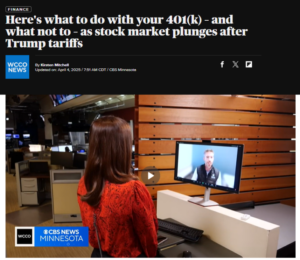
According to a recent article, many Americans are seeing their retirement savings, particularly in 401(k) plans, take a hit. CBS News Minnesota interviewed Mission Wealth Senior Wealth Advisor Jon DeMoss about steps to take if you feel uneasy. DeMoss says the key to weathering market downturns is a focus on individual financial goals. You can watch the full interview by clicking the link or image above.
As previously mentioned, broadly diversified portfolios have held up relatively well year to date, with major asset classes outside of U.S. stocks performing positively.
International and emerging market stocks remain positive so far this year (despite the substantial increase in trade tensions). Real estate, private equity, the broad bond market, and direct lending strategies have all generated positive returns. As a result, Mission Wealth’s broadly diversified portfolios have held up well year to date, despite the heightened levels of uncertainty.
We continue to monitor developments closely. To the extent uncertainty and heightened volatility persists, we may have enhanced rebalancing opportunities to add to high-quality assets at relatively cheap entry prices, which in turn may help underpin long-term portfolio returns.
Mission Wealth is a Registered Investment Adviser. This commentary reflects the personal opinions, viewpoints, and analyses of the Mission Wealth employees providing such comments. It should not be regarded as a description of advisory services provided by Mission Wealth or performance returns of any Mission Wealth client. The views reflected in the commentary are subject to change at any time without notice. Nothing in this commentary constitutes investment advice, performance data, or any recommendation that any particular security, portfolio of securities, transaction, or investment strategy is suitable for any specific person. Any mention of a particular security and related performance data is not a recommendation to buy or sell that security. Mission Wealth manages its clients’ accounts using a variety of investment techniques and strategies, which are not necessarily discussed in the commentary. Investments in securities involve the risk of loss. Past performance is no guarantee of future results.
KEY TAKEAWAYS
Schedule a complimentary 30-minute discovery call to discuss your unique situation and financial goals.

"*" indicates required fields
By providing a telephone number and submitting the form, you are consenting to be contacted by SMS text message and agreeing to our privacy policy and disclaimers. Message frequency may vary. Message and data rates may apply. Reply STOP to opt out of further messaging. Reply HELP for more information.

Client Development Advisor
or call us: 805-902-4550
"*" indicates required fields
Schedule a complimentary 30-minute discovery call to discuss your unique situation and financial goals.
Prefer a phone call? Call us: 805-902-4550
For general inquiries: click here.
By providing a telephone number and submitting the form, you are consenting to be contacted by SMS text message and agreeing to our privacy policy and disclaimers. Message frequency may vary. Message and data rates may apply. Reply STOP to opt out of further messaging. Reply HELP for more information.