



It’s been a bumpy start to the year, with uncertainties surrounding tariffs currently dominating headlines. We’ve highlighted our thoughts below:
President Trump announced that the U.S. would proceed with 25% tariffs on Canadian and Mexican-made goods and doubled the China tariff rate to 20% on Tuesday, March 4, 2025. In response, China announced 15% tariffs on U.S. chicken, wheat, corn, and cotton, and 10% tariffs on sorghum, soybeans, pork, beef, seafood, fruits, vegetables, and dairy. Canada said it will proceed with plans to impose 25% tariffs on approximately $20 billion of U.S. goods, which may be followed by a second round of tariffs on CAD $125 billion in three weeks. Mexico’s President Sheinbaum said retaliatory tariffs on the U.S. are expected to come this Sunday.
It is a fluid situation, and we are still in early stages with more tariff developments to come. The hope is that tariffs remain primarily a negotiation tactic and may be dialed back. Nevertheless, these developments have caused a recent uptick in market volatility around fears of a more drawn-out, tit-for-tat trade war.
We have seen concerning headlines and crises before. Investors should expect bumps along the road–volatility is par for the course for an investment in the stock market. That being said, discipline and a long-term focus have been rewarded time and time again. Over the years, there have been numerous concerning headlines, but the market has consistently produced positive returns over the long haul. We expect this time to be no different.
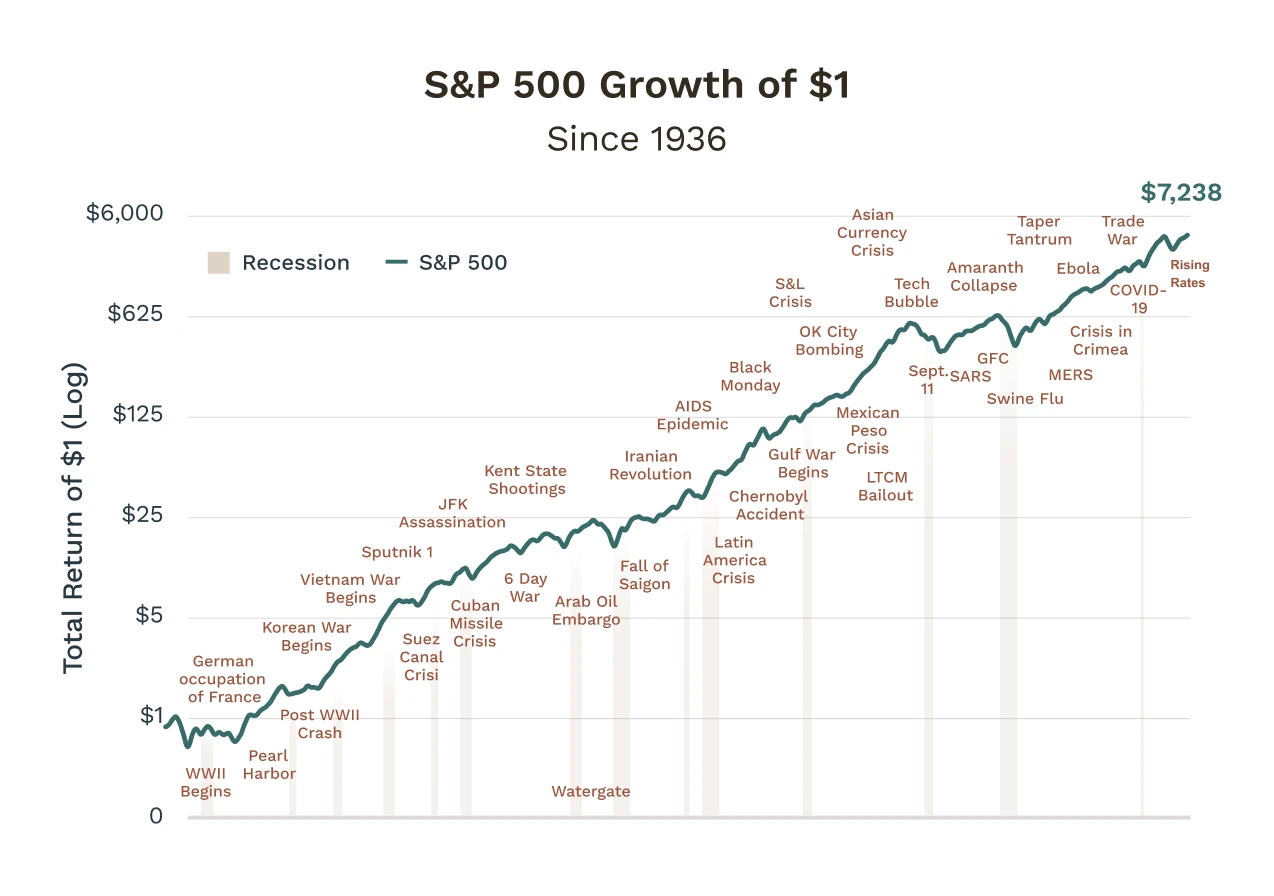
U.S. Stocks: S&P 500 Index as of 12/31/2023. Index returns represent past performance, are not a guarantee of future performance, and are not indicative of any specific investment. Indexes are unmanaged and cannot be invested in directly.
The market tends to overreact during the short run but is tied to underlying fundamentals over the long run. Economic fundamentals are still in place. While we have seen some moderation in economic data recently, the underlying economy appears resilient. We maintain close communications with all our investment partners, who invest in thousands of businesses throughout the economy. Despite the current headlines, the overarching feedback remains optimistic about future growth potential.
Underlying business fundamentals continue to be strong and robust. Revenue and profit growth remain broadly positive, and companies are experiencing record margins. Businesses are seeing increases in productivity due to investments in technology, particularly artificial intelligence (AI). Enhanced productivity is very important in extending the current economic expansion, and surveys of company management indicate an increase in capital expenditures in the months ahead.
Credit has increased with improved bank lending, and money supply is positive and accelerating. Bank balance sheets are in much better shape, and there are lower levels of structural leverage in the banking system. Household balance sheets are healthy, with many metrics near record levels. In turn, this has helped underpin robust consumer spending, which is the backbone of the U.S. economy, making up nearly 70% of the GDP.
In short, economic fundamentals remain resilient, and we do not see any major excesses in the economy. It’s those excesses that tend to perpetuate downside risks. As such, we remain positive about the long-term outlook for growth.
The importance of broadly diversified investment portfolios cannot be overstated. Having all your eggs in one basket may work over short periods of time, but it tends not to be sustainable over the long haul. While the performance of the U.S. stock market has been dominated by the “Magnificent 7” over recent years, that has recently changed. Year-to-date, Value stocks have significantly outperformed Growth stocks, and international stocks have significantly outperformed U.S. stocks. Moreover, other asset categories, such as bonds, real estate, private equity, and direct credit, have fared much better than the broad U.S. stock market.
This episode of uncertainty is a good example of why we believe in constructing portfolios that have different exposures to various elements of the market. Allocating to assets that can zig when others zag can provide considerable downside protection.
Staying invested and disciplined is critical to the long-term success of an investment portfolio. With respect to rebalancing, our disciplined approach forces us to “buy low, sell high.” Through this lens, any ongoing volatility may be used to our advantage, providing a greater ability to add to high-quality assets on weakness, which may, in turn, enhance long-term performance.
We continue to monitor developments closely. Overall, we believe our portfolios are well positioned to navigate the current uncertainty and continue to meet our clients’ long-term goals. If you have questions about your portfolio management or want to learn more about Mission Wealth, please get in touch with us below.
Mission Wealth is a Registered Investment Adviser. This commentary reflects the personal opinions, viewpoints, and analyses of the Mission Wealth employees providing such comments. It should not be regarded as a description of advisory services provided by Mission Wealth or performance returns of any Mission Wealth client. The views reflected in the commentary are subject to change at any time without notice. Nothing in this commentary constitutes investment advice, performance data, or any recommendation that any particular security, portfolio of securities, transaction, or investment strategy is suitable for any specific person. Any mention of a particular security and related performance data is not a recommendation to buy or sell that security. Mission Wealth manages its clients’ accounts using a variety of investment techniques and strategies, which are not necessarily discussed in the commentary. Investments in securities involve the risk of loss. Past performance is no guarantee of future results.
KEY TAKEAWAYS
Schedule a complimentary 30-minute discovery call to discuss your unique situation and financial goals.

"*" indicates required fields
By providing a telephone number and submitting the form, you are consenting to be contacted by SMS text message and agreeing to our privacy policy and disclaimers. Message frequency may vary. Message and data rates may apply. Reply STOP to opt out of further messaging. Reply HELP for more information.

Client Development Advisor
or call us: 805-902-4550
"*" indicates required fields
Schedule a complimentary 30-minute discovery call to discuss your unique situation and financial goals.
Prefer a phone call? Call us: 805-902-4550
For general inquiries: click here.
By providing a telephone number and submitting the form, you are consenting to be contacted by SMS text message and agreeing to our privacy policy and disclaimers. Message frequency may vary. Message and data rates may apply. Reply STOP to opt out of further messaging. Reply HELP for more information.