


At Mission Wealth we follow a disciplined approach to rebalancing, reviewing accounts on at least a quarterly basis for rebalancing opportunities.

Ever wondered what the benefits of portfolio rebalancing are? How do financial professionals keep portfolios balanced over time? Click the video to watch, or read the text beneath it to learn more.
What is rebalancing? Simply put, it is a process whereby we sell assets that have experienced relative outperformance in favor of assets that have experienced relative underperformance. On the one hand it ensures our client portfolios maintain alignment with their defined risk-return target profiles – for instance that a 60% stock / 40% bond portfolio doesn’t migrate towards a 70% stock / 30% bond allocation. On the other hand, disciplined rebalancing implicitly forces us to follow a “buy low, sell high” methodology and has proven to add value over time.
So, let’s see how rebalancing works in practice. Let’s assume a very basic portfolio made up of just two asset classes – let’s assume just stocks and bonds with an equal target allocation of 50% to both.
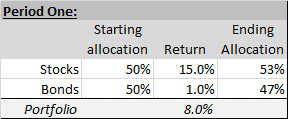
Now, let’s also assume some return parameters over two separate periods. In period one, stocks do very well and return +15%, while bonds trail, returning just +1%.
Again, we start with a 50% allocation to stocks and a 50% allocation to bonds. By the end of the first period, the total portfolio returns 8%, however the allocation split between stocks and bonds changes to 53% stocks and 47% bonds as a result of the relative outperformance of stocks.
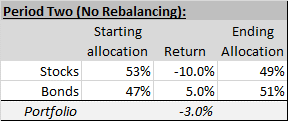
Now let’s assume that in the second period stocks sell-off and lose -10%, while bonds rally, returning +5%.
Now, let’s also assume we make no adjustments to the portfolio entering period two. At the end of the second period, the portfolio would have lost -3.0%.
However, had we rebalanced the portfolio back to the original 50% stocks / 50% bonds target allocation, the portfolio would only have lost -2.5% during the second period, resulting in a +0.5% performance enhancement.
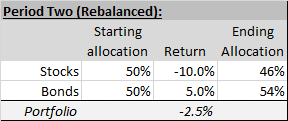
Obviously this is a hypothetical example over two periods with just two asset classes but it highlights the importance of a disciplined, periodic rebalancing methodology.
Our portfolios are typically made up of multiple asset classes within both stocks and bonds – such as large cap, small cap, US stocks and international stocks – to name just a few. Each additional asset class provides another opportunity to leverage the benefits of disciplined rebalancing, by trimming an asset on relative strength in favor of another asset class that has recently underperformed.
The benefits of disciplined rebalancing may be enhanced during times of market volatility. The following chart indicates the potential benefits of rebalancing during times of market dislocation, such as the period 2005 through 2014, which encompasses the Great Financial Crisis of 2008.
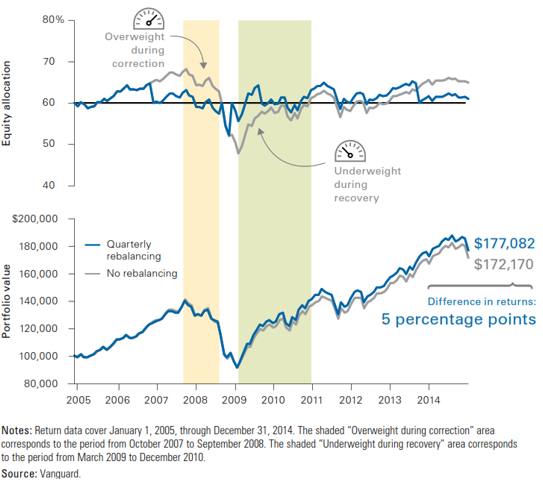
In this example, quarterly rebalancing added a full five percentage points to total return on a portfolio.
Indeed, following a disciplined approach to rebalancing has proven to add value over extended periods of time, with average estimates of 0.89% of additional annual portfolio performance benefits.
These benefits underscore the reasons why we follow a disciplined approach to portfolio rebalancing at Mission Wealth. If you’d like to learn more about our investment services, check out our investments page.
00366685 5/20
Mission Wealth is a Registered Investment Adviser. This commentary reflects the personal opinions, viewpoints, and analyses of the Mission Wealth employees providing such comments. It should not be regarded as a description of advisory services provided by Mission Wealth or performance returns of any Mission Wealth client. The views reflected in the commentary are subject to change at any time without notice. Nothing in this commentary constitutes investment advice, performance data, or any recommendation that any particular security, portfolio of securities, transaction, or investment strategy is suitable for any specific person. Any mention of a particular security and related performance data is not a recommendation to buy or sell that security. Mission Wealth manages its clients’ accounts using a variety of investment techniques and strategies, which are not necessarily discussed in the commentary. Investments in securities involve the risk of loss. Past performance is no guarantee of future results.
KEY TAKEAWAYS
Portfolio rebalancing is the process of selling outperforming assets and buying underperforming ones to maintain your target allocation, effectively enforcing a disciplined “buy low, sell high” approach. Without regular rebalancing, a portfolio can drift toward a riskier allocation than intended, leaving investors overexposed during market downturns. Studies show that disciplined quarterly rebalancing can add significant value over time, with benefits particularly pronounced during periods of market volatility.
Schedule a complimentary 30-minute discovery call to discuss your unique situation and financial goals.


By providing a telephone number and submitting the form, you are consenting to be contacted by SMS text message and agreeing to our privacy policy and disclaimers. Message frequency may vary. Message and data rates may apply. Reply STOP to opt out of further messaging. Reply HELP for more information.

Client Development Advisor
Kyle Buffo, CFP®
Client Development Advisor
Schedule a complimentary 30-minute discovery call to discuss your unique situation and financial goals.
Prefer a phone call? Call us: 805-902-4550
By providing a telephone number and submitting the form, you are consenting to be contacted by SMS text message and agreeing to our privacy policy and disclaimers. Message frequency may vary. Message and data rates may apply. Reply STOP to opt out of further messaging. Reply HELP for more information.
For general inquiries: click here.