


No results can be found

As election day approaches, political headlines and economic discussions can shape how investors interpret information, assess risk, and make decisions. During periods of uncertainty, it’s natural to weigh potential risks more heavily, seek information that reinforces existing beliefs, or feel a greater need to act. Recognizing these tendencies can help you distinguish a thoughtful response to changing circumstances from a reaction driven by short-term concerns.
Our educational pieces are designed to maintain perspective and engage in ongoing conversations with your advisory team, who can help keep investment decisions aligned with the broader objectives your wealth is meant to support.
With this in mind, we want to share our thoughts on interest rates and the bond market.
The Fed held interest rates steady at its latest October FOMC meeting, maintaining its target for the fed funds rate at 3.75% – 4.00%. The decision was widely anticipated, with markets assigning a greater than 90% probability that the Fed would leave interest rates unchanged ahead of the meeting. That said, it was no foregone conclusion: two Committee members voted against the decision, preferring to raise interest rates by 0.25% at this meeting.
The statement noted that economic activity is expanding at a strong pace, supported by productivity growth, capital investment, and resilient domestic spending, despite geopolitical uncertainty. The statement also indicated the labor market remains balanced, with job gains keeping pace with the workforce and little change in the unemployment rate. At the same time, the statement was unambiguous: inflation remains elevated. Though, it also indicated the need for additional data, stating the accumulation of more information will help the Committee determine the policy stance appropriate to ensure a timely return of inflation to the Committee’s 2 percent goal.” It appears the Fed is again in “wait-and-see” mode.
At his subsequent press conference, Fed Chair Warsh reiterated the Fed’s commitment to restoring price stability. He acknowledged that while economic activity is robust and the employment side of the Fed’s dual mandate is well-balanced, inflation continues to run above the Fed’s 2% target. In Warsh’s view, the Fed’s recent “monetary medicine” appears to be working, with tighter financial conditions and well-anchored inflation expectations helping move the economy toward a more sustainable period of economic growth and price stability. That said, he emphasized the need to assess the full economic impact of recent monetary tightening before deciding on the next steps for policy. As he put it, the coming period will be “information rich,” giving policymakers more data to inform their decisions.
Perhaps the most important takeaway came later in the press conference, when Warsh said the Fed does not judge the economy to be too hot and causing inflationary pressures. Essentially, a robust economy does not necessarily warrant additional monetary tightening. Rather, the Fed appears increasingly focused on assessing whether existing policy measures are sufficient to bring inflation back toward its long-term target. In turn, policymakers may be more patient in considering further interest rate increases than markets had previously anticipated.
We believe markets had recently become overly aggressive in anticipating future Fed rate increases, contributing to the recent move higher in bond yields. After touching 5.3%, the benchmark 10-year Treasury yield has retraced back towards 5.0%, though still well above the 4.1% level at the start of the year. While markets had been pricing in about four additional Fed rate hikes, we believe the Fed’s September “dot plot” forecasts, which indicate one more 0.25% interest rate increase this year before pausing in 2027, are more likely.
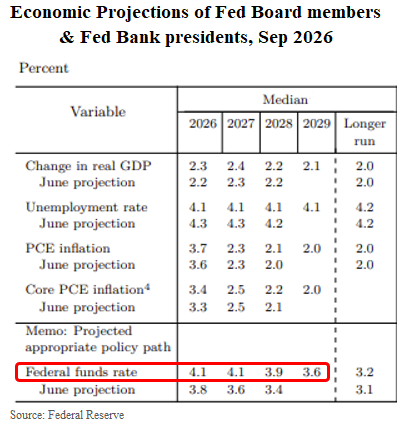
We believe the Fed would need to see a meaningful change in the economic backdrop to warrant an adjustment to its indicated path for interest rates. A resolution to the ongoing conflict in the Middle East could also provide a disinflationary tailwind, although we are not anticipating a near-term resolution.
We believe the current interest rate environment presents one of the more attractive opportunities for high-quality core fixed income. Higher starting yields provide a meaningful income cushion against any potential increases in interest rates, while also offering attractive upside potential should yields move lower. Should market expectations for Fed rate increases continue to moderate, we would anticipate containment in yields around current levels, if not some downward pressure.
The bond math is increasingly compelling. As a reminder, there is a negative correlation between interest rates and bond prices: as interest rates rise, bond prices tend to fall, weighing on bond returns; as interest rates fall, bond prices tend to increase, acting as a tailwind for bond returns. The duration metric approximates the impact of a 1% change in yields (plus or minus) on bond prices.
Using the broad bond market – as measured by the Bloomberg U.S. Aggregate Bond Index – as an example:
Historic data indicate solid mid-single-digit forward-looking returns for the broad bond market.
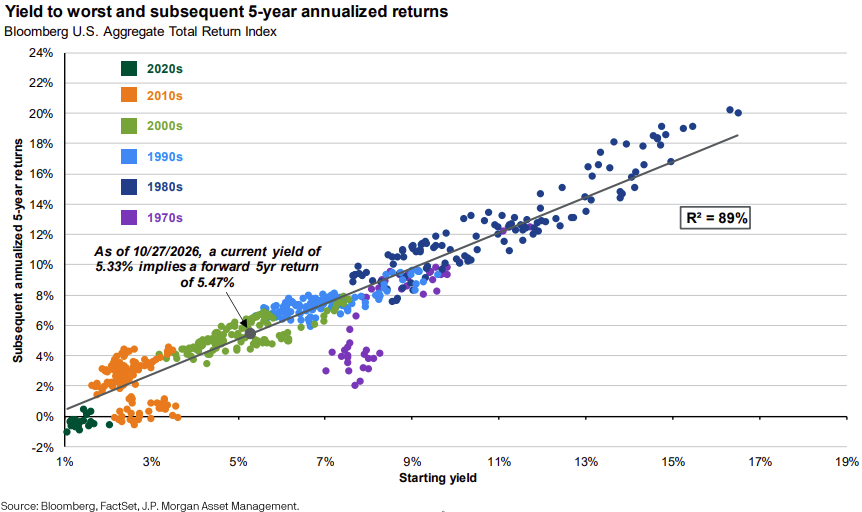
Based on a similar analysis of Mission Wealth’s preferred core bond fund holdings, and under the same +/-100bps 12-month scenario, we estimate that a 1% increase in yields over the coming 12 months would result in approximately flat total returns. Conversely, a 1% decline in yields could generate total returns in the low teens. Our base case expectation, assuming a relatively stable interest rate environment, if not a slight decline in yields, is mid- to high-single-digit core fixed income returns over the coming 12 months. Obviously, these are expectations only, and will depend on changes in interest rates, credit spreads, and other market conditions.
Beyond the attractive near-term return potential, high-quality bonds remain a cornerstone of our broadly diversified investment portfolios. Bonds provide a consistent income stream, help moderate overall portfolio volatility, and may offer valuable downside protection during periods of economic weakness or equity market stress. Importantly, fixed income can respond differently than stocks across market cycles, providing diversification benefits and a source of liquidity for portfolio rebalancing.
We also continue to favor allocations to floating-rate, alternative, income-oriented asset classes like direct credit, which provides a complementary source of income exposure. These strategies may benefit from higher short-term interest rates as the coupons on the underlying loans reset higher. At the same time, the resilient economy remains supportive of underlying borrower fundamentals, while senior-secured positioning provides meaningful downside protection should economic conditions deteriorate.
While the precise path of interest rates remains uncertain, we believe today’s elevated starting yields offer a compelling combination of income, downside cushion, and potential capital appreciation. We remain constructive on fixed income and believe maintaining dedicated allocations to high-quality bonds, alongside broadly diversified equity and alternative investments, remains an important component of helping clients achieve their long-term financial goals.
As always, should you have any questions, please don’t hesitate to contact your Wealth Advisor.
Contact us today for a complimentary consultation and review of your investment portfolio.
Mission Wealth is a Registered Investment Adviser. This commentary reflects the personal opinions, viewpoints, and analyses of the Mission Wealth employees providing such comments. It should not be regarded as a description of advisory services provided by Mission Wealth or performance returns of any Mission Wealth client. The views reflected in the commentary are subject to change at any time without notice. Nothing in this commentary constitutes investment advice, performance data, or any recommendation that any particular security, portfolio of securities, transaction, or investment strategy is suitable for any specific person. Any mention of a particular security and related performance data is not a recommendation to buy or sell that security. Mission Wealth manages its clients’ accounts using a variety of investment techniques and strategies, which are not necessarily discussed in the commentary. Investments in securities involve the risk of loss. Past performance is no guarantee of future results.
KEY TAKEAWAYS
Schedule a complimentary 30-minute discovery call to discuss your unique situation and financial goals.

"*" indicates required fields
By providing a telephone number and submitting the form, you are consenting to be contacted by SMS text message and agreeing to our privacy policy and disclaimers. Message frequency may vary. Message and data rates may apply. Reply STOP to opt out of further messaging. Reply HELP for more information.
or call us: 805-902-4550
"*" indicates required fields
Schedule a complimentary 30-minute discovery call to discuss your unique situation and financial goals.
Prefer a phone call? Call us: 805-902-4550
For general inquiries: click here.
By providing a telephone number and submitting the form, you are consenting to be contacted by SMS text message and agreeing to our privacy policy and disclaimers. Message frequency may vary. Message and data rates may apply. Reply STOP to opt out of further messaging. Reply HELP for more information.