






7:15
The Psychology of Moving into a Retirement Home
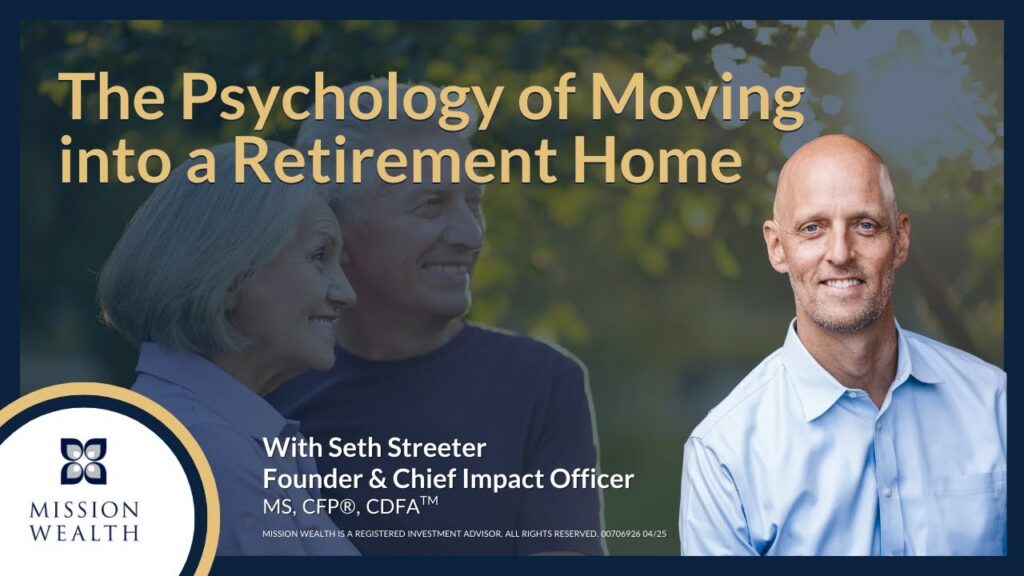
[Music] Why is it so hard to leave home? Well, deciding to move into a retirement community is truly one of the most emotionally complex financial decisions that a person will make. And even when it may make sense for health care, social engagement, or financial stability, our brains often resist. At Mission Wealth, we help individuals and families navigate this transition by understanding the psychological patterns that make it difficult in quantifying the impacts of the transition to ensure it makes financial sense. Below, we explore three psychological traps that can cloud judgment and allow you to make more informed choices with the help of your financial adviser. Psychological trap number one, the endowment mindset. This explains sentimentality. We place a greater value on things that we own and have familiarity with. Your home isn’t just a building. It’s where you raised a family, built memories, and created a peaceful haven and grew as a person. This emotional attachment makes it hard to let go even when moving might improve your quality of life. Real life example. In a classic study by Conman, Nch, and Thaylor, students from Cornell University were randomly given a coffee mug that sells for $6 at the campus store. When asked for how much they would sell it to other students, they were unwilling to sell it for anything less than $712. While those without a mug were willing to pay $287 for it. Even though the sellers knew that the mug could be purchased for the store at $6, less than their $7 selling price, they resisted selling their mug because their ownership created an inflated sense of value. This study became one of the most widely replicated studies across the world. And if we assign more value to owning a randomly assigned mug that we didn’t have when we started the day, imagine how much value we assign to our cherished homes. When applied to housing, this truly means that retirees often resist selling their homes even when upkeep is burdensome. Costs are high, healthcare access and safety are growing concerns. And a planning tip is just to talk to your adviser about modeling a transition to a retirement community. As part of our wealth management process, we can build a hypothetical scenario that models out the finances of making this change. And this allows us to quantify the net proceeds of selling your home, what the annual costs of the community are, and considering any required health care costs that you may have. We can even compare this to a hypothetical scenario where you stay in your current home, but you pay out of pocket for specialist healthcare providers to come to you. Reframe the move. Instead of focusing on what you’re losing, focus on what you’re gaining. Less maintenance, more convenience, built-in healthcare, and a vibrant social environment. Consider a short-term stay. Experience life in a new setting can often reduce the feeling of loss by showcasing what’s possible before you fully commit and or sell your home. So, maybe try it out and see what you think. Psychological trap number two, representativeness. So, imagine you meet someone named Steve and he’s quiet, detail- oriented, and introverted. If you had to guess, is he more likely to be a librarian or a truck driver. Well, most people will say librarian because he fits the stereotype. But in reality, there’s far more truck drivers than librarians, making it much more likely that Steve is a truck driver. Fun fact, estimates by the trucking association put the number of US truck drivers at 3.5 million versus just 150,000 librarians. This study shows representative bias, our tendency to judge based on how much something seems to fit a mental stereotype rather than reality. The same bias affects how we think about retirement communities. Many people picture dreary hallways and isolation. While modern communities are often lively, social, and full of amenities quite different, letting outdated stereotypes drive decisions can lead to missed opportunities for a far better lifestyle. In truth, modern retirement communities are often vibrant and provide residents with a lot of lifestyle benefits, healthy dining, fitness centers, social events, and access to personal health care. So, for these positive realities might be overshadowed by these ingrained stereotypes. So, a planning tip is visit in person. Schedule site visits at multiple retirement communities and see them for yourself and see if your outdated mental image is really what reality is today. And also feel free to talk to your adviser about speaking to some other clients who might be able to give you their own personal experience of living in these communities. And also you could talk to friends or family members that have more direct experience himself. Psychological trap number three, projection tendency. This tendency makes us believe that our future selves will feel exactly as we do today. This is why people often think I’m independent now so I won’t need assisted living later. I don’t need these services yet, so I won’t need them in the future. I feel comfortable in my home today, so I will prefer staying here long term. This also overlaps with status quo thinking, which makes us resistant to change, even when it could be for the better. People delay moving to a retirement community because they assume the discomfort of change outweighs the benefits of planning ahead. Real life example. A study in the quarterly journal of economics found that people struggle to predict how their needs and preferences will evolve. Participants expected their future selves to maintain the same movie, music, and hobby preferences. Yet over time, their interests changed far more than they anticipated. We can even feel this when we think about who we were just 5 or 10 years ago. Often feeling like prior versions of oursel are almost unrecognizable. When applied to our health, this pattern causes people to put off a necessary move until a health crisis forces a rushed decision, often leaving fewer options. Planning tips. Making a proactive decision, not a reactive one, instead of waiting for a crisis. Consider moving while you still have control over the decision and can explore all available options. Even something as simple as getting on a waiting list, which could be several years, is a good way to give yourself the future option without committing to the move today. Talk to your future self and ask, “If my health changed tomorrow, would I be prepared?” Have your financial adviser model out what it would cost and the logistics if you needed skilled health care sooner than you expected. Will your financial plan be safe if you chose not to participate in a retirement community but still needed advanced health care? If you believe your children will be able to provide your future caregiving, have an honest conversation with them if this is feasible given their other family and career responsibilities. Final thoughts. Moving into a retirement community isn’t just a financial decision. It’s an emotional one. By recognizing and overcoming these natural thinking patterns, you can make a proactive choice that aligns with your future well-being rather than being forced into a rush decision later. At Mission Wealth, we help individuals and families navigate these transitions with clarity and confidence. If you’re considering a move, we’d love to help. Visit our health planning and retirement pages to learn more about making smarter financial and lifestyle decisions for retirement. [Music]
Deciding to move into a retirement community is one of the most emotionally complex financial decisions a person can make. Our brains often resist even when it makes sense—whether for healthcare, social engagement, or financial stability.
At Mission Wealth, we help individuals and families navigate this transition by understanding the psychological patterns that make it difficult and quantifying the impacts of the transition to ensure it makes financial sense.
In this video, we explore three key psychological traps that can cloud judgment—and how to make more informed choices with the help of your financial advisor.
1. Endowment Mindset
2. Representativeness Shortcut
3. Projection Tendency
Read the full article by Founder and Chief Impact Officer Seth Streeter here: https://missionwealth.com/psychology-of-moving-into-a-retirement-home/
Mission Wealth is a Registered Investment Adviser. This commentary reflects the personal opinions, viewpoints, and analyses of the Mission Wealth employees providing such comments. It should not be regarded as a description of advisory services provided by Mission Wealth or performance returns of any Mission Wealth client. The views reflected in the commentary are subject to change at any time without notice. Nothing in this commentary constitutes investment advice, performance data, or any recommendation that any particular security, portfolio of securities, transaction, or investment strategy is suitable for any specific person. Any mention of a particular security and related performance data is not a recommendation to buy or sell that security. Mission Wealth manages its clients’ accounts using a variety of investment techniques and strategies, which are not necessarily discussed in the commentary. Investments in securities involve the risk of loss. Past performance is no guarantee of future results.
"*" indicates required fields
By providing a telephone number and submitting the form, you are consenting to be contacted by SMS text message and agreeing to our privacy policy and disclaimers. Message frequency may vary. Message and data rates may apply. Reply STOP to opt out of further messaging. Reply HELP for more information.

Client Development Advisor
or call us: 805-902-4550
"*" indicates required fields
Schedule a complimentary 30-minute discovery call to discuss your unique situation and financial goals.
Prefer a phone call? Call us: 805-902-4550
For general inquiries: click here.
By providing a telephone number and submitting the form, you are consenting to be contacted by SMS text message and agreeing to our privacy policy and disclaimers. Message frequency may vary. Message and data rates may apply. Reply STOP to opt out of further messaging. Reply HELP for more information.